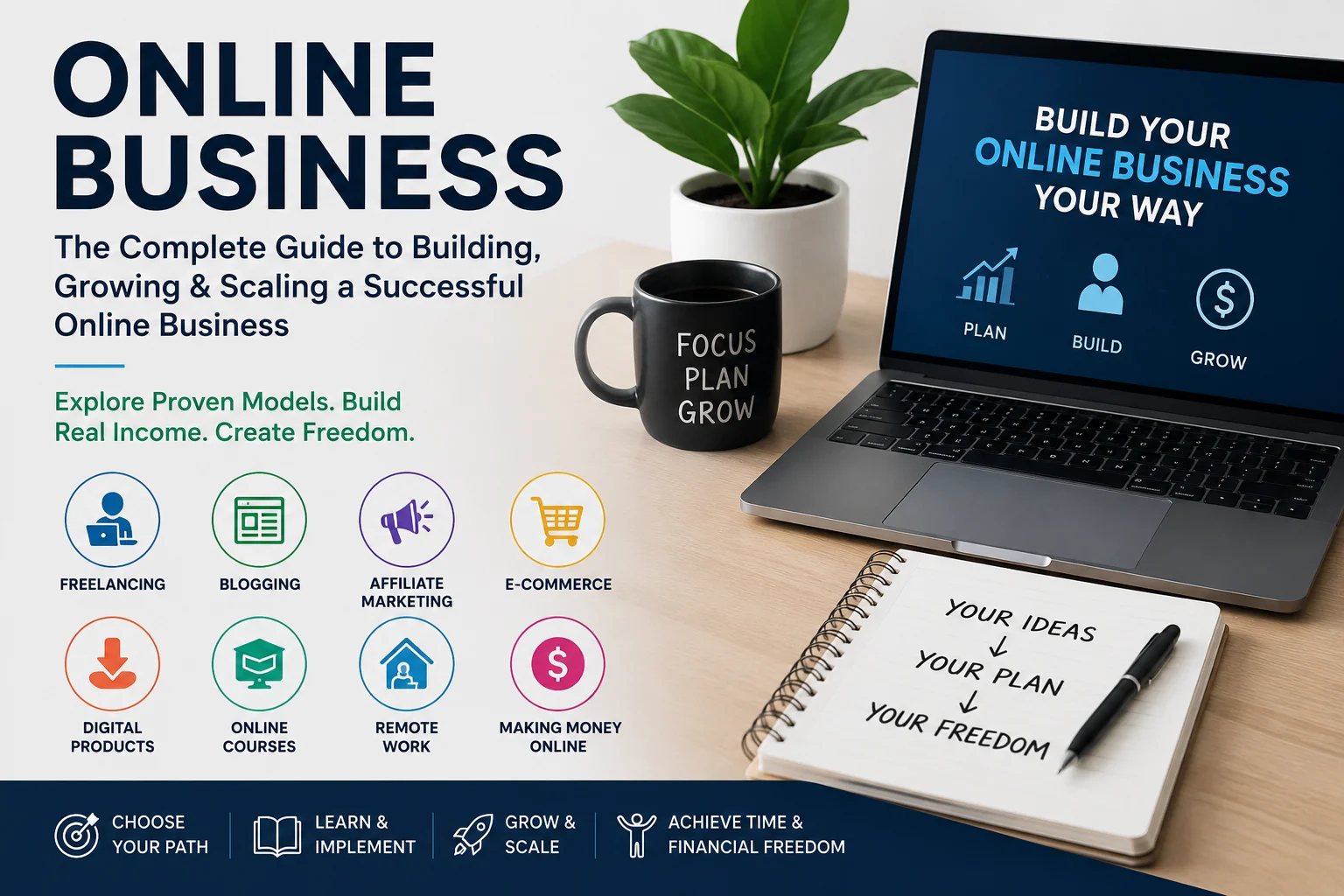
Building an online business is certainly easier than it was 10 years ago, but scaling one to create consistent revenue is still quite challenging. You need a laptop, an Internet connection, and a couple of digital tools to get started, but generating income online is increasingly more complicated than just throwing up a website and social media collage. You have to know who your people are, what issue you can help solve, how you will find those people, how the business is going to generate revenue, and why someone should choose you over one of the dozens of alternatives already in existence.
The phrase “online business” encompasses a wide range of income-generating methods. Freelancers provide professional services to clients, while bloggers attract an audience and monetize it through advertising, sponsorships, affiliate sales, or products and services. An e-commerce entrepreneur sells physical products, a creator creates digital products or online courses, and an affiliate marketer earns commissions from every customer they refer to other companies. Remote workers can earn a living online even if they’re employees, not entrepreneurs.
These models frequently overlap. Later, a freelance designer will sell design templates, a blogger may try affiliate marketing, develop an online course, or open an e-commerce store. An employee on mute (you defend yourself after a certain number of years of professional experience) might start consulting. One dependable income stream within successful online businesses generates the expertise, exposure, credibility, cash flow, or distribution needed to create another.
In this guide, you will learn about significant online business models, the way they work, where their strengths and weaknesses are, and how to determine which path could be right for you. Importantly, it emphasizes creating something useful and long-lasting rather than treating making money online as a get-rich-quick scheme.
What Is an Online Business?
A company whose activity is based either partially or completely on the internet to market and sell its products, process transactions, provide value for the customer, manage operations, or a combination of these activities. The business need not be digital-only. A physical e-commerce company may sell online and run warehouses, but a consultancy could hold virtual meetings while solving real problems in organizations. A course creator can share knowledge online, and a freelance developer may connect with clients thousands of miles away.
These businesses share a common thread: they remove many traditional geographical and operational barriers through a more widespread internet. A startup can interact with customers worldwide, accept payments electronically, deliver digital goods nearly instantly, offload parts of its workflow to robots, and leverage software that once required entire departments. While this makes solo-preneurships and small teams possible, it also means many markets are crowded, because the number of people looking to drop out is always high. Most online markets are unregulated and therefore easy to enter.
Which is why having an online presence alone is no longer a competitive edge. If anyone can set up a store, publish blog posts, promote freelance services, or create an online course for free, then what is the advantage? Differentiation provides a foundation for competitive advantage in sustainable businesses, typically based on some combination of specialization, knowledge, a better product or superior customer experience, trusted brands, streamlined operations, unique distribution, or access to an addressable audience that competitors cannot readily replicate.
Which is to say, it helps to think of the internet as infrastructure; not so much that it is the business. A channel could be your website, marketplace account, newsletter, social media profile, YouTube channel, or online store. Your business is the setup to find demand, create value, reach the target market, convert some of them into customers, deliver on what was promised, and keep just enough margins alive to keep singing.
How Online Businesses Actually Make Money
Although online businesses can vary a lot in appearance, most rely on one of three main economic models. Understanding those models helps you assess opportunities and choose the one that fits your skill set, resources, and risk appetite.
A service business sells knowledge and work for money. This includes freelancing, consulting, virtual assistance, design and development services for small businesses and dev shops (such as bookkeeping or marketing), and translation work. Service businesses can build revenue quickly because they don’t require thousands of visitors or customers to become a concern. Sometimes, only a few well-valued clients can generate meaningful earnings.
In essence, a commerce business generates revenue by selling an item for more than it costs to buy and deliver — including acquiring and producing the product, plus marketing and delivery. This includes traditional e-commerce stores, marketplace sellers, subscription-box businesses, print-on-demand brands, and direct-to-consumer companies. While revenue can grow quickly, the model introduces operational complexities around inventory fulfillment, payment processing or accounts receivable, customer acquisition and retention (especially on the eCommerce side), supplier management, and returns logistics, which in many cases go hand-in-hand with selling physical goods online.
A business that earns your attention and trust, then manages your monetization. That’s how blogs, newsletters, podcasts, YouTube channels, and some social media businesses operate. Monetization can come through advertising, affiliate commissions, sponsorships, memberships, consulting gigs, digital products, or physical products later on. The audience becomes more than just a number on the CV, as that is one way to repeatedly reach people who want to hear about something in particular.
A knowledge business is when you package your expertise into something you can sell repeatedly. This model (in various shapes and forms) has been used through online courses, paid workshops, guides, templates, research reports, memberships, coaching programs, toolkits, and other digital products. The creator spends time creating a useful resource, then sells access to many customers without starting from scratch for every deliverable.
An affiliate business generates commissions if recommendations result in qualifying purchases or other desired actions. The affiliate typically doesn’t own the product it links to, so its most valuable assets are its content, audience, distribution, trust, comparison expertise, or purchase influence. Affiliate marketing is very successful if the publisher offers real value to consumers.
The core point is each model needs a different route to profitability. An e-commerce business (which a course creator might never consider) has to factor in margins and fulfillment. A freelancer never needs as much traffic volume for an ad-supported blog to be viable. Before selecting a model, understand exactly where the revenue comes from, what costs drive that revenue, and what needs to be true for the economics to work.
Choosing the Right Online Business Model
There you have it — no single online business model is the №1 best system. The best option is derived from your skills, the amount of capital you have access to, how much time you can afford at the moment, the risk that you’re willing to take on, uncertainty regarding distribution channels, ease with selling or creating products for sale versus services, as well as what your objectives are. A model that works perfectly for one person might not work at all for another.
Freelancing is practical if you have a marketable skill and wish to rake in the dough much sooner than starting from scratch by building an audience. Instead of waiting for search traffic or social distribution to build up, you reach out directly to potential clients. If you enjoy research, writing, publishing, and building expertise over time, blogging may be a better fit (a way to develop an owned information asset).
Affiliate marketing only works when you join a community and help people with their purchasing decisions. Instead of producing generic promotional content, you can make comparisons and buying guides for software, financial tools, home equipment, or even travel services. E-commerce might be a more natural fit for entrepreneurs passionate about products, merchandising, customer experience, suppliers, logistics, branding, and conversion optimization.
This means that digital products and online courses might work perfectly for you, as long as you have the kind of knowledge or repeatable processes that people find valuable. Remote work is a different story: even though it doesn’t require entrepreneurship, you can still make money entirely through a screen. It can also become a springboard for future entrepreneurial endeavors, as it grooms professionals to build greater skills, understand industries, widen networks, and amass savings.
Instead of “What online business is the most profitable? Instead, ask a better question: “What business model will give me the best legitimate edge with what I have right now in terms of tools, information, and windows of opportunity? The question that leads to much better decisions is about fit, not hype.
Freelancing: Turning a Marketable Skill Into an Online Business
Freelancing is the easiest type of online business as it has a clear exchange value. You have a skill an individual or business needs, and they pay you to deliver it. Professions such as writers, graphic designers, developers, SEO professionals, video editors, translators, virtual assistants, and accountants/consultants/researchers/marketers/photographers (you get the point) can all provide services remotely.
The main advantage of freelancing is that the gap between learned skills and earned revenue can be small. You don’t need to invent inventory, get hundreds of thousands of visitors, and spend months building a complicated service before landing your first customer. As long as you can find a business that has a clear problem, and then prove to the business owner that your service provides the solution for that problem, you could start validating your service right now.
Most freelancers with any degree of success never freelance a general skill. Positioning works even better when the service is linked to a specific customer and result. “I am a freelance writer” is a lot less precise than “I help B2B software businesses write technical articles that attract qualified organic traffic.” The second sentence gives the right customer exactly what they need to know about why a freelancer might be relevant.
Freelance marketplaces are becoming a crutch for you as a beginner, because those platforms already have buyers looking for talent. Marketplaces are great, but you should never be 100% dependent on a single platform, as it creates concentration risk. Last but not least, platform status quo such as fees, ranking system (who gets what), competition, or a change of algorithm, restrictions on accounts & excesses of certain platforms get out of reach for the freelancer either way. A more robust freelance business slowly builds several customer-acquisition channels, including the following: Referrals, Direct Outreach, Professional Networking, Search Traffic, Community / Industry Partnerships, Independent Portfolio Site
Over time, freelancers move from novice to expert, build a strong reputation, and adjust their pricing structure accordingly. Sincerely, newbies set hourly rates because they’re easy to understand, while pros are more likely to use project pricing, retainers, service packages, or value-oriented pricing. There is no one best way to price—scope of work, certainty of scope, client relationship, and the directness with which you provide services that tie back to business outcomes all factor into the pricing formula.
Freelancing does not need to turn into an agency. Others deliberately choose to stay independent specialists because some people prefer control, flexibility, and a smaller client base. Some outsource via subcontractors, offer productized services, form small teams or leverage freelance experience into consulting, digital products, courses or software.
What Makes Freelancing Sustainable?
The best way to secure more freelance work long-term isn’t to work yourself to death chasing hours; it’s to become more valuable. That is, doing more specialized work, building a stronger reputation, delivering reliably, and keeping clients will raise the average revenue per project and take the constant effort of getting new clients off the table. One freelancer provides a specific solution to a particular type of problem and becomes known for it, allowing her to price the service more strongly than another freelancer with an unrelated service list.
Freelancers also need to realise that working independently involves a whole business. Freelancers need to consider income upfront — it can change, payments might not happen at all times when they are needed, and the freelancer needs to arrange contracts, taxes or Bookkeeping or even insurance and retirement often taken care of by an employer Requirements differ considerably by country and legal concept, therefore any individual earning freelance or gig earnings ought to examine the rules relevant in their very own jurisdiction.
Blogging: Building an Audience and an Owned Content Asset
Blogging is often framed as a passive-income opportunity, which obscures much of the effort required to build a successful publication. A serious blog operates more as a mini media company. It finds an audience, learns what that audience needs, creates useful stuff, builds trust, distributes content assets and updates key resources year on year — and somewhere in that cycle converts a small part of that attention into revenue.
Search traffic can be a major channel for acquisition, but this means nothing in the world if you create a blog to publish pages around keywords. According to Google’s people-first guidance, helpful, reliable material that demonstrates real expertise, depth of coverage, originality, and value to users is essential. That principle is more relevant than ever because it has become far easier to create huge amounts of non-specific information.
An editorial territory is the bones of a sustainable blog. If your website lacks a clear audience and covers unrelated topics, you will find it hard to build recognisable expertise or reader loyalty. A more focused publication can instead produce related content that answers different questions for the same type of reader, so individual articles support the overall topic rather than compete with it.
This is where pillar content and topic clusters come in very handy. The topic page is a central resource that gives readers an overview, while narrower supporting resources explore targeted questions in much greater detail. Internal links should facilitate natural movement between these resources and not just exist for SEO reasons.
Blogs earn money through ads, affiliates, sponsorships, membership sites, services (like coaching), newsletters/digital products, and e-learning. Depending on audience size and trust, reader purchasing intent, and the kind of problem the publication helps readers solve, choose the right monetization model. Even a small business blog, if it reaches real business decision-makers, may provide more utility through consulting or niche products than an entertainment publication.
Blogging Is an Asset-Building Strategy
A well-curated library of useful content is also one of blogging’s biggest strengths, becoming a business asset the company owns. The company has more control over its website than it does over visibility on a social platform, but search traffic will never be 100% guaranteed either. Rankings fluctuate, competitors make progress, and algorithms change all the time—but if you have content that is properly managed, it can bring in new readers for months or even years on end (and links too), fuelling your sales conversations and email list while creating expertise along the way.
So the goal should not be to create an infinite treadmill of publishing. That’s a far more manageable goal than creating the largest library of strong resources that truly have a right to exist, cover important user needs, and allow for ongoing improvement as information changes. Maintaining an archive can be much more valuable than hundreds of shallow articles!
Affiliate Marketing: Earning Through Trusted Recommendations
A publisher, creator, marketer, or business can earn money through affiliate marketing by referring customers to another company to purchase a product or service. The mechanics are very simple: an affiliate receives a trackable link or referral method, and when a visitor makes a qualifying transaction, the affiliate may get paid.
The challenge is earning the qualified attention and trust needed for those recommendations to matter. Weak affiliate content often begins with the commission — you find high-ticket products and make content that primarily moves users towards links. Great affiliate content starts with whatever decision the reader is making.
An effective software comparative piece, for instance, might talk through which tool is better for a small business, which works great with bigger teams, what limitations users should be aware of, and outline features that are worth the extra cost (and those that aren’t), as well as when neither product is the right option. Even if no purchase takes place, that kind of content benefits the reader.
And that alignment between reader value and commercial interest is what makes affiliate marketing sustainable. Because affiliate marketers recommend only things that solve a problem and work properly, they can earn commission without sacrificing the content. If a publisher pushes only the highest-commission products, trust can be lost quickly.
Transparency is also essential. Publishers must prominently disclose compensated relationships and comply with any applicable advertising and consumer-protection laws in their jurisdiction. Disclosures should be easy for readers to find, not hidden in obscure policy pages.
Building an Affiliate Business That Can Last
Affiliate businesses should not rely on a single merchant or program. Things that cut commission rates, change attribution rules, remove products, shut programs down, amend geo-targeting, and terminate an affiliate account. A business wholly dependent on one partner represents a serious platform and merchant risk.
The audience relationship is the more long-lasting asset. Similarly, a publisher that finds real value in a category can often evolve even if one program launches or shuts down. Strengthen credibility Original testing, no-nonsense comparison methods for transparency when comparisons are used, first-hand experience where possible, obvious dates for updates to content, pros and cons contents that make it crystal clear what your products offer over their competitors − without making unrepresentative claims about either or overstating the balance of pros or cons (anything can be an issue depending on how you look at it), explanations of who should not purchase a given product.
Affiliate marketing is particularly effective when used with blogging, newsletters, video content, social media, or niche communities because these channels help you reach the right people. The affiliate link is just the monetization outlet; the real business is in the trust and attention you build before someone clicks it.
E-Commerce: Selling Physical Products Online
E-commerce is the most high-profile aspect of online business. This covers everything from independent online shops to marketplace sellers, DTCs, subscription businesses, dropshipping operations, POD and multi-channel retailers who sell both in physical stores and through e-commerce. You can take this model to niche businesses of any size or even global behemoths.
It’s easy to see why, given that consumers increasingly expect to find, examine, purchase, and review products online. But just because there are a ton of people online to sell to doesn’t mean every ecommerce store is easy to make profitable. E-commerce companies should be aware of far more than just wholesale vs retail price.
Eventually, revenue has to cover product cost, shipping & packaging, payment-processing fees (Amazon or merchant accounts), returns and damages, advertising software, marketplace fees, customer service labor, taxes, warehousing, and more. Just because a product sells for $50 and the cost of sales is $20 does not mean there is a $30 profit. That’s why unit economics actually fucking matters.
A sane business already understands, before aggressively scaling up advertising: what a customer costs, with average unit economics remaining after all direct costs, refund and return rates vs average order value, repeat-purchase behavior, and fulfillment expenses so we can understand actual contribution margin. Sales can grow like wildfire while the business fades if every additional sale loses money.
Choosing an E-Commerce Model
There are different ways entrepreneurs can go about their e-commerce. While selling existing products can reduce product-development needs, this strategy can also lead to intense direct competition. Companies with existing manufacturing capabilities can compete, but private-label businesses set themselves apart by differentiating through brand (and potentially positioning), packaging, and distribution. These original products offer greater defensibility, but generally require more capital, trial, and development.
With dropshipping, your suppliers send orders straight to your customers, which means less need for stock. This may remove one operational hurdle, but it does not remove the customer-service duty. Even when a third party oversees production and fulfillment, the seller still controls the customer experience.
The print-on-demand principle works the same way for clothing, books, posters, accessories, and other custom goods. Production happens after an order, which reduces inventory risk. Margins, production quality, shipping speed, and product differentiation are harder to manage.
No matter how they do it, winning e-commerce companies tend to go beyond just simply having a product available. However, brand positioning and content that build trust, merchandising, customer support, checkout process, delivery times, product data useful to customers when making purchase decisions, and above all high lifetime value through high retention rates and differentiated products are advantages that will be much harder to replicate.
Digital Products: Creating Something Once and Selling It Repeatedly
The attractiveness of digital products is that they can often be sold without holding physical inventory. For example, it could be a template, spreadsheet, design asset, software as a service (SaaS), ebook, report, or plugin/preset/stock media/membership/downloadable resource/calculator/specialized toolkit.
It also does not make these businesses easy just because there is no physical inventory. The hard work shifts somewhere else. You have to find a problem worth solving, build a solution, sell it, support it, update it, and if its use wanes or the underlying technology changes (this will happen), maintain what you built.
Great digital products almost always save the purchaser time (in a meaningful way), produce a better outcome, structure complex information, make an experience inefficient to reproduce, or enable access to something otherwise inconvenient. When products clearly relate to a specific problem, customers can more easily understand why they deserve their money.
Take a generic product— a social media template pack, for example—and thousands of similar products are fighting for attention. Pencil-in clutter-free announcement and open-house graphics, testimonial layouts, concise market-update templates, sizing instructions, and customization guidance for a much clearer customer with a more effective job to complete.
Validate Before Building Too Much
You can spend months building something only to confirm later whether someone is interested. Whenever possible, validate before investing at the highest levels. A freelancer might notice the same client requesting the same spreadsheet multiple times, a blogger might get recurring questions from readers, or a consultant might repeatedly find customers struggling with the same implementation process.
Those signals are often more actionable than just discovering that a keyword has search volume. In doing so, the creator can validate demand through customer conversations, a small pre-launch audience, a waitlist, a minimum viable version, a pilot release, or early sales. The best validation is when people are willing to pay, even something as simple as money, time, or some commitment for this solution.
When true demand is present, a digital product can provide high leverage because, once delivered, you can sell it again and again without rebuilding the deliverable 100 times for each customer. That doesn’t eliminate marketing or support, but it changes the time-to-revenue relationship.
Online Courses: Selling Structured Knowledge and Transformation
Online courses are a specific type of digital product, but we must separate them as customers generally acquire more than information. They are purchasing a structured journey to a desired destination. What you may find is that information itself is abundant — and any subject can be studied for free via search engines, videos, forums, libraries, and public resources.
Your course must therefore do more than log information into video lessons. That value might be through sequencing, curricular structure, exercises/templates/feedback/community/accountability/instructor access/examples/pathway.
The best courses start with a clear learner and an achievable transformation. The goal “learn digital marketing” is extremely vague, while the goal “build your first Google Ads campaign for a local service business” is very specific. The learner understands the scope, the result, the target, and the course’s relevance.
Course creators should not suggest excessive salaries or career opportunities either. Many factors outside the instructor’s control, such as what they may have encountered before, effort put in, market conditions at the time, and implementation, mean that a student’s outcome will vary. When people have more realistic expectations because of honest positioning, they tend to be less dissatisfied.
Self-Paced, Cohort & Hybrid Programs
Those are flexible, as self-paced courses allow students to learn on their own time. They also let you reach multiple customers without scheduling each lesson live. However, without accountability or support, completion rates can suffer.
Cohort-based programs take a group of learners through the material together. While the instructor needs to put in more effort with live sessions, deadlines, peer discussions, feedback, and shared progress can drive much stronger engagement.
Hybrid programs use recorded material, plus 1:1 coaching, office hours, or community access. The right delivery model should be dictated by what you need to accomplish the desired result, not the easiest way to sell. Technical skills that can be taught in a short self-paced format may be ideal. In contrast, complex professional development that benefits from feedback and interaction may not work as well.
Remote Work: Earning Online Without Necessarily Owning a Business
Remote work is often grouped with online entrepreneurship, but the distinction matters. A remote worker is usually in an employment relationship with an employer, while a freelancer or contractor works more independently. A remote generally works directly for an employer with an employment relationship. At the same time, a freelancer or contractor operates more independently and is responsible for more elements of acquiring clients/pricing / going concern.
Both can make most of their money doing only digital work. Technology, marketing, finance, design, writing, customer success and experience, project management, and data analysis are among the most popular job functions in knowledge industries, with roles that can easily transition to remote work.
The best strategy for job seekers is not to look for any job with the tag that says “remote.” Niche areas of work suited for remote roles tend to have a lot more competition, so specific expertise, quantifiable results, and effective communication skills, as well as tool utilization and the ability to work independently, become critical differentiators.
Jobseekers should also look at what remote really means for each position. Some companies let employees work from anywhere in their country, while others limit remote work to specific states, regions, or time zones. While most roles are fully remote, some require occasional in-office visits or a hybrid arrangement.
Remote Employment, The Gateway To Entrepreneurship
Remote jobs are a less risky way to tiptoe into the digital economy before you get around to starting a business. An employee can learn how firms function, build technical skills, see the dark sides of customer problems, study helpful systems in their environment, build business contacts, and save money while improving income predictability.
That experience can then support freelancing, consulting, product development, or a business. A remote marketer becomes a solo consultant, a software developer builds an online product, or an operations powerhouse grows into a niche service business.
But there’s no need to be an entrepreneur. A stable work-from-home career can be a great goal on its own. For many people, getting a job that pays better or offers more flexible hours is a more rational first step than starting an unpredictable business.
Making Money Online: Separate Real Business Models From Hype
“Making money online” is one of the most general terms in the Internet Marketing crown. It draws in authentic entrepreneurs, professionals wanting extra income, students building new skills, creators/freelancers, and anyone who wants a better shot at the cash game. But with any new frontier comes the inevitable unrealistic promises and flawed schemes.
If you see automated income claims, mystery system traps, easy passive income, guaranteed-payout promotions, or business opportunities that promise you never have to do any work—don’t just take them at face value. Normal economic laws still govern real online income. This is because someone is offering labor, skills, goods, access, entertainment, info, technology, or some other form of value to another person or entity willing to pay for it.
Freelancing exists because companies need skilled services. E-commerce exists because clients want goods. Affiliate marketing is powerful because people make purchasing decisions based on recommendations that they find useful. Courses exist because learners appreciate structure in their education. Blogging creates value by informing or helping the audience, and remote jobs exist because employers need someone to do useful work.
When you understand where value comes from, opportunities are easier to evaluate. Who pays, what they get in return from you, why they’d keep paying, what costs are involved, and your offer’s differentiators/replaceability. However, if those questions go unanswered in a convincing way — then the opportunity is worth an awful lot more examination
How to Start an Online Business Step by Step
Details vary by business model, but the underlying process is surprisingly consistent. Most successful online businesses start by understanding a specific audience, validating demand, creating a focused offer, reaching potential customers, building trust, and improving the economics before scaling aggressively.
Start With a Customer Problem, Not a Business Trend
Beginners often start by asking what they can sell. A stronger starting point is identifying who they can help and what problem is worth solving. A web developer doesn’t simply sell code; the client may need more leads, faster checkout, a better customer experience, or a more reliable system. An online course does not merely sell videos; it may help someone pass an exam, perform a job better, or acquire a valuable skill.
The same principle applies to products. Customers may buy for convenience, comfort, status, entertainment, identity, safety, efficiency, or another outcome. Understanding the deeper reason behind the purchase makes positioning and marketing much easier.
Validate Demand Before Making Large Investments
Validation means collecting evidence that people care enough about a problem to take action. Search behavior can provide one signal, competitor activity can provide another, and marketplace demand, customer interviews, online communities, reviews, existing client requests, sales data, and successful products can all reveal useful information.
None of those signals guarantees that your particular business will succeed, but they reduce blind speculation. Validation becomes stronger when someone is willing to exchange money, time, contact information, or another meaningful commitment for what you offer.
Create the Smallest Useful Offer
New entrepreneurs often build far too much before they have customers. They design complicated websites, create dozens of products, record enormous courses, develop elaborate branding, and buy expensive software before proving demand.
A better first version solves the central problem with the least unnecessary complexity. A consultant can begin with one clearly defined service, an e-commerce store can start with a focused product range, a digital-product creator can release a tightly scoped toolkit, and a course creator can teach one transformation well.
Early customers provide information that planning alone cannot. Their questions, objections, complaints, purchasing behavior, and feedback reveal what deserves improvement.
Choose One Primary Customer-Acquisition Channel
A new business rarely needs to be everywhere. Freelancers may prioritize direct outreach or networking, while a content business may focus on organic search. An e-commerce brand might begin with paid social advertising, creator partnerships, or marketplace traffic, and an educator may choose email or professional communities.
Additional channels can be added later. Trying to master SEO, YouTube, multiple social networks, paid advertising, cold email, podcasting, and partnerships simultaneously usually leads to shallow execution across the board.
Build Trust Before Trying to Scale
Online customers face uncertainty because they cannot always meet you, inspect the product physically, or verify your promises in person. Trust therefore becomes part of the offer. Clear contact information, realistic claims, transparent policies, customer reviews, case studies, secure payment systems, useful content, responsive support, professional presentation, and visible authorship can all reduce uncertainty.
For information businesses, sourcing matters most. Content should clearly demonstrate who created it, why they are qualified to discuss the topic, what evidence supports important claims, and when the material was last reviewed. Trust becomes even more important in financial, legal, health, employment, and other high-stakes topics.
Measure Economics Before Scaling
Growth magnifies whatever already exists. If customers are profitable and satisfied, growth can strengthen the business. If advertising loses money, returns are excessive, support is overwhelmed, or retention is poor, scaling only makes those problems bigger.
Before increasing volume aggressively, understand revenue, direct costs, customer-acquisition cost, conversion rates, refunds, repeat purchases, fulfillment expenses, and the time required to deliver the product or service. A business should know whether its growth creates value rather than assuming that higher revenue automatically means stronger performance.
How Much Does It Cost to Start an Online Business?
Startup costs vary enormously depending on the model. A freelancer with an existing computer, reliable internet connection, and marketable skill can begin with relatively little additional capital. A blogger may initially need a domain, hosting, and publishing tools, although high-quality research, editing, and content creation still require substantial time.
Digital products can also start lean because there may be no physical inventory. At the same time, e-commerce can require considerably more capital for inventory, samples, packaging, product photography, fulfillment, software, and advertising. Online courses fall somewhere in between. A simple live workshop can be delivered using basic tools, while a sophisticated course platform with professional production and paid marketing can require much more investment.
Don’t confuse low entry cost with zero cost. Time has value, payment processors charge fees, software subscriptions accumulate, marketing requires money or labor, customers may request refunds, and businesses may need registration, tax support, insurance, contracts, licenses, or professional advice depending on their activities.
Instead of asking for the absolute minimum to start, estimate what you need to test the idea responsibly. The objective should be to learn whether customers want the offer before committing more resources than the evidence justifies.
Traffic Is Not the Same as a Business
One of the most important distinctions in online entrepreneurship is the difference between attention and economics. A website can receive thousands of visitors and generate very little revenue, while another business may operate profitably with only a few dozen highly qualified prospects.
Traffic becomes valuable when it contains people relevant to what you offer and when the business can convert some of that attention into worthwhile outcomes. Search traffic is valuable because users often reveal specific needs through their queries. Social media can provide distribution and community, email creates a more direct audience relationship, paid advertising can generate predictable exposure when the economics support it, and partnerships can provide access to audiences a business may struggle to reach independently.
Strong online businesses usually avoid treating any single external platform as permanent. Search algorithms change, social reach can decline, advertising costs rise, and marketplaces modify policies. An email list, recognizable brand, customer database, useful content library, proprietary expertise, differentiated products, and repeat customers are more durable assets because a platform change cannot remove them as easily.
SEO and Content Strategy for Online Businesses
Search engine optimization can support many online business models, but SEO works best when it is connected to the customer journey. A freelance consultant can publish resources around problems potential clients face, while an e-commerce company can create useful category pages, detailed product information, buying guides, comparisons, and support content. A digital-product company can answer questions related to the problems its products solve.
Keywords remain valuable because they reveal how people describe their needs, but they should not become the content’s purpose. The strongest pages satisfy a clear user intent while using the language people naturally search for. Titles, headings, internal links, page structure, and descriptive content should all help users and search engines understand what the page is about without resorting to repetitive keyword stuffing.
Legal, Tax, and Compliance Responsibilities Still Apply Online
Operating online does not remove normal business responsibilities. Requirements vary according to country, state or province, business structure, industry, customer location, and the type of product or service being sold. Depending on the circumstances, an entrepreneur may need to consider business registration, taxation, licenses, privacy requirements, contracts, consumer-protection laws, intellectual-property rules, advertising standards, employment regulations, or sales taxes.
Freelancers and gig workers may also have tax obligations that differ from those of traditional employees. Affiliate marketers and creators should consider advertising disclosure requirements, while e-commerce companies may need clear policies covering returns, shipping, privacy, warranties, and customer rights.
These issues matter because financial and legal rules change over time and differ significantly by jurisdiction. General online advice should never replace professional legal or tax guidance when the consequences are significant.
Good compliance is not simply about avoiding penalties. Transparent policies, responsible marketing, accurate claims, and clear customer communication also build trust.
Common Online Business Mistakes
Many online businesses struggle for ordinary reasons, not mysterious ones. One common mistake is copying a successful business model without understanding why the original company works. Two businesses can sell similar products or services yet achieve completely different results because one has better distribution, stronger customer relationships, more capital, superior economics, deeper expertise, or clearer positioning.
Another mistake is confusing activity with progress. Designing logos, changing website themes, purchasing software, watching courses, and constantly planning content can feel productive without creating evidence that customers actually want the offer. Real progress usually appears in customer conversations, sales, retention, referrals, improved economics, and better delivery.
Dependence on one platform is another major risk. Businesses built entirely around one marketplace, traffic source, social account, or advertising channel can become vulnerable to changes they do not control. Diversifying customer acquisition and building owned assets can reduce that exposure over time.
Some entrepreneurs scale too early by increasing advertising, hiring employees, purchasing large amounts of inventory, or expanding product lines before proving that the core economics work. Others remain too broad, making it difficult for customers to understand why the business is particularly relevant to them.
Finally, many people underestimate consistency. Online businesses can be launched quickly, but expertise, brand recognition, reputation, customer relationships, traffic, operational systems, and trust usually compound slowly. The ability to keep improving after the initial excitement disappears is often more important than discovering a fashionable business model.
How to Build More Than One Online Income Stream
Multiple income streams can strengthen an online business when they develop naturally from the same audience, expertise, or customer problem. A freelance marketer may start with consulting, turn recurring processes into templates, create a training course, and eventually earn affiliate commissions from tools they genuinely use in the work.
A blogger may combine advertising, affiliate marketing, digital products, sponsorships, and a newsletter. An e-commerce brand might add subscriptions, wholesale distribution, complementary digital resources, or carefully selected partnerships.
The advantage is leverage because the same knowledge, reputation, or audience can support several ways of creating value. The danger is distraction. Trying to build five revenue streams before one works usually fragments attention and prevents any of them from becoming strong.
A more disciplined approach is to establish a reliable core model first and expand when customer behavior reveals a sensible adjacent opportunity. Diversification should strengthen the business and make it more resilient, not just more complicated.
Building an Online Business That Can Remain Valuable for Years
Digital tools change quickly, but fundamental business principles change much more slowly. Durable online businesses understand their customers, solve meaningful problems, manage cash carefully, build trust, control enough of the customer relationship to survive platform changes, and improve their offers based on real evidence.
Technology, including artificial intelligence, can improve research, administration, customer support, analysis, design, coding, marketing, and content workflows. These tools can increase productivity, but they also make generic output easier for competitors to reproduce. That increases the value of original experience, strong judgment, customer relationships, proprietary knowledge, distinctive brands, and genuinely useful products.
The important question is not simply how much work can be automated. Entrepreneurs should ask which parts of the business customers genuinely value and which advantages competitors still find hard to copy.
A business that remains useful for years is rarely built around a temporary tactic alone. It develops capabilities, relationships, systems, and assets that continue creating value even as technology and platforms change.
Frequently Asked Questions About Online Business
What Is the Best Online Business for Beginners?
There is no single best option, but service businesses such as freelancing are often practical for beginners with a marketable skill. They can pursue customers directly without first building a large audience or investing heavily in inventory. Someone with different strengths may be better suited to blogging, e-commerce, digital products, online courses, or another model.
Can I Start an Online Business With Little Money?
Yes. Freelancing, consulting, blogging, and some digital-product businesses can start with a relatively modest financial investment. However, low startup costs don’t mean no cost, because time, skills, marketing, software, payment processing, and business administration still require resources.
How Long Does an Online Business Take to Become Profitable?
There is no reliable universal timeline. A freelancer may acquire a paying client quickly, while a blog or audience-based business may require considerable time before monetization becomes meaningful. Profitability depends on the business model, market demand, expenses, pricing, customer acquisition, competition, expertise, and execution.
Is Blogging Still a Viable Online Business?
Yes, but success depends much more on quality than simply publishing large quantities of articles. Blogs that develop genuine expertise, strong topical coverage, original value, trusted authorship, and a clear audience can support advertising, affiliate marketing, services, products, newsletters, and other revenue streams.
Is Affiliate Marketing a Real Business?
Yes. Affiliate marketing is a legitimate performance-based marketing model in which a publisher earns compensation for qualifying referrals. Sustainable affiliates create value by helping audiences discover, compare, understand, or use products while clearly disclosing commercial relationships where required.
Is Remote Work the Same as Freelancing?
No. A remote employee generally works for an employer while performing the job away from a traditional office. Freelancers operate more independently and usually provide services to clients. The distinction can affect taxes, benefits, legal protections, contracts, and business responsibilities.
Can Digital Products Generate Passive Income?
Digital products can create scalable revenue because you can deliver the same core product repeatedly, but truly passive income is uncommon. Product development, marketing, updates, customer support, payment management, refunds, and ongoing improvement usually require continued work.
Should I Build a Website Before Starting an Online Business?
A website is useful for many businesses, but it is not always the first requirement. A freelancer can validate a service through direct outreach, an e-commerce seller can test products through a marketplace, and a course creator can begin with a live workshop. Once the business is validated, an independent website can become an important long-term asset for branding, lead generation, content, customer relationships, and sales.
Which Online Business Can Make the Most Money?
Potential revenue varies too widely for a meaningful universal ranking. E-commerce companies can produce substantial revenue but may operate on thin margins, while specialized consultants can serve relatively few clients with high margins. Software and digital products can scale efficiently but may be difficult to create and distribute successfully. Focus on customer value, economics, and competitive advantage rather than headline revenue.
Is Making Money Online Safe?
Legitimate online work and entrepreneurship can generate real income, but scams also target people searching for online opportunities. Be cautious about guaranteed income, vague business models, unusual upfront payments, unrealistic returns, and claims that significant earnings require virtually no effort. Always understand who pays you, what value they receive, and why the arrangement makes economic sense.
Where Should You Start?
Online business is not one opportunity. It is an ecosystem of different ways to create and exchange value. Freelancing converts expertise into services, blogging builds an audience and information asset, affiliate marketing monetizes useful recommendations, e-commerce sells physical products, digital products package repeatable resources, online courses transform expertise into structured learning, and remote work provides location-flexible employment.
You do not need to pursue all of these models at once. Choose the path that best connects your current resources to a real customer need. Learn enough about the market to identify a problem worth solving, create a focused offer, test whether people will pay for it, build trust, understand the economics, and improve what works before adding complexity.
The internet makes it possible to reach customers almost anywhere, but it does not remove the fundamentals of business. Sustainable online companies still succeed for familiar reasons: they understand people, solve worthwhile problems, deliver what they promise, manage money responsibly, adapt to change, and earn enough trust for customers to return or recommend them.