When you own a business, you have to make financial decisions nearly every day. You get to pick what you can afford to purchase, when to go for hiring, if and how much you are going to borrow, what portion of cash in hand you are going to have, where money needs prioritization, how you need to prepare for taxes, and whether it is worth your time pursuing the opportunity. These are separate decisions, yet they fall within the scope of business finance.
Business finance refers to the methods a business uses to understand, acquire, control, protect, and plan its financing. It links accounting records with cash flow, banking, borrowing, credit, taxes, valuation, budgeting and forecasting, and long-term finance decisions. By bringing these areas together, a business owner can make decisions based on facts and figures rather than the current bank balance or gut feeling.
This gives us no indication of whether a business is actually financially healthy. If a company is selling more, it may still struggle to pay its vendors. It can show a profit while waiting months for customers to pay their bills. It may borrow funds to expand but find the repayment schedule mismatches its cash cycle. You can also grow a business of great value — only to neglect the books needed to prove that value earnestly, to allow you some form of financing with which to build and grow.
New research from the Federal Reserve illustrates how intertwined these issues are. According to the 2025 Small Business Credit Survey, 60% of employer firms reported having applied for financing over the past year. 56% of firms seeking financing cited paying ongoing operating expenses as their motivation, and expansion or pursuing a new opportunity as another key reason. The same study found that applicants received the full amount sought in only 42% of cases. These findings demonstrate an important principle in finance: access to money is much easier to manage when accounting, cash flow, credit, banking, debt capacity, and planning work together.
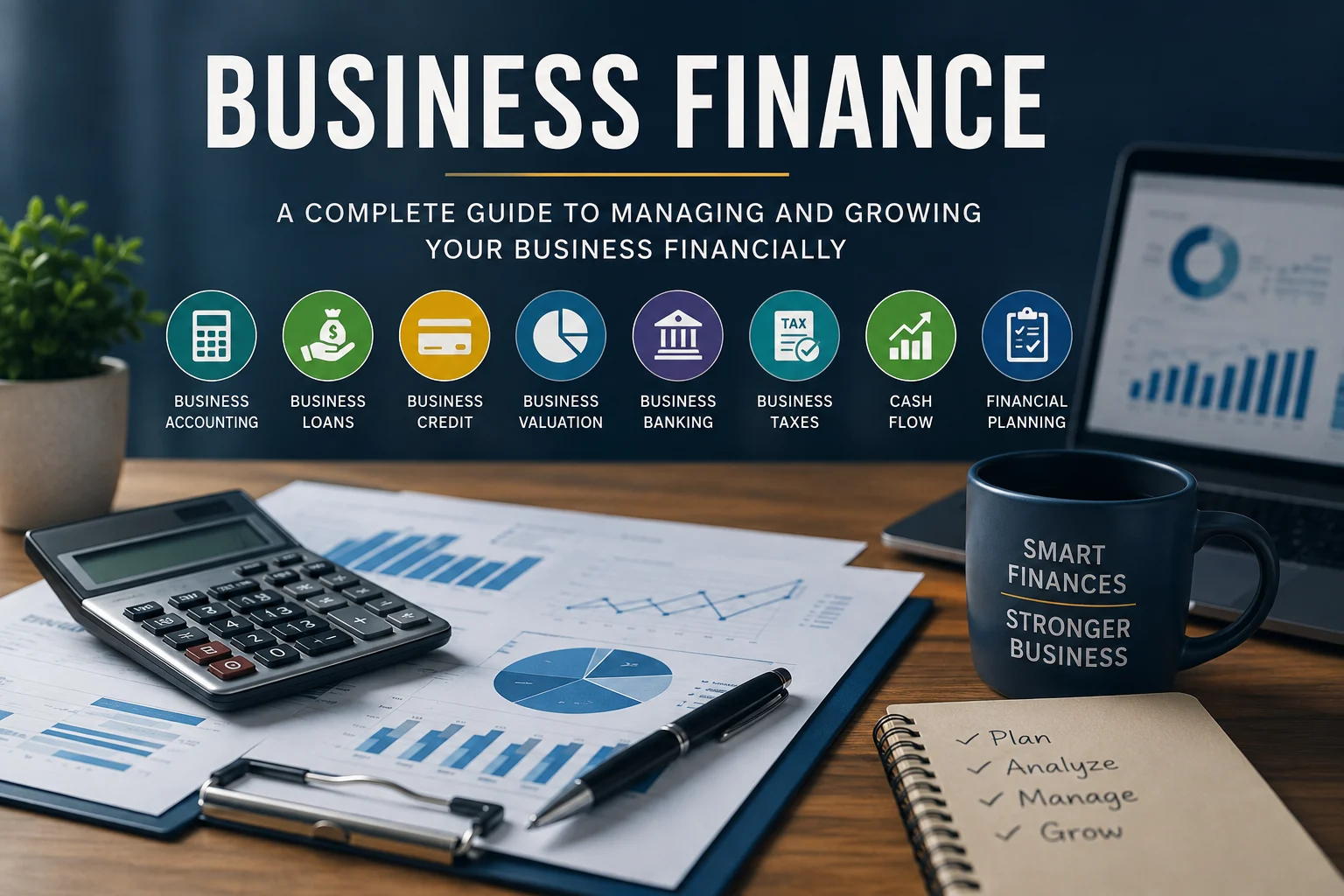
This Business Finance guide lays out the bigger picture for entrepreneurs and small business owners. It provides an overview of the main financial topics every business owner needs to understand, from Business Accounting and Business Loans to Business Credit, Business Valuation, Business BI, and Business Banking & Assets. Interested in investing in the stock market? The subject is intricate enough that this pillar focuses on how major pieces operate, their relevance, and how they interconnect. From there, they can refer to the exclusive Businesslineer guides for an in-depth look at each topic.
Please note that this guide is for educational purposes and does not constitute financial, accounting, tax, investment, or legal advice. Businesses have different financial and tax requirements depending on their structure (or type), industry, geographic location, and other individual factors. Identifies hints to U.S. regulations, when appropriate, and advises the business owner to visit with competent professionals if a decision is known to have significant legal, tax, or financial ramifications.
What Is Business Finance?
Business finance defines how a company manages the funds needed to start, maintain, secure, and expand the business. This includes, but is not limited to, understanding where the money goes, where it comes from, how efficiently it is used, the company’s financial risk, and how current decisions will affect future use.
You should train in business finance, not accounting. Accounting constructs and organizes the financial, historical record of what has occurred. Finance then uses those records, along with forecasts and business goals, to guide what happens next. For example, accounting might tell you that gross profit was lower last quarter. Financial management asks what caused the drop, whether the price should change, and whether it will impact cash flow enough that the firm cannot afford its planned investment.
So the business needs not just to know how well it is performing given past realities, but also to have financial information. Planning without reliable records is hit-or-miss. Great records (the ones that describe what happened) without planning (which item to do next based on those descriptions) will not help the owner financially.
The U.S. Small Business Administration emphasizes this relationship, with advice on business finance management that includes items such as “Pay yourself a salary” and “The money belongs to your business.” It calls good record-keeping and a solid understanding of business finance necessary to sustain an ongoing venture, and it calls balance sheets, cash flow projections, accounting methods, and financial analysis essential management tools.
Another way of looking at business finance is as a decision-making system. It will even help determine if the business can hire another employee, or the affordability of a new location, or if a loan will return more value than it costs— along with many things like whether a customer is taking too long to pay, inventory is locking up too much cash, or if the owner has enough to prepare for taxes and future expansion adequately.
A solid financial system doesn’t eliminate uncertainty. Business always involves uncertainty. The key to effective financial management is making that uncertainty more visible and manageable.
Why Strong Business Finance Matters
A business run financially typically has a better understanding of its strengths, weaknesses, and boundaries. With a cash flow forecast, the owner can track a growing cash shortfall rather than discovering it when payroll is due. Rather than competing for financing without knowing what the lender will see, the owner can evaluate financial statements, debt obligations, credit history, and payment capacity before applying.
Financial discipline directly enhances the quality of decisions made in the enterprise. Take, for example, two businesses making $500 000 in sales each year. One with a reasonable margin, collects customers quickly, has low debt, solid bookkeeping and adequate liquidity to withstand a handful of rough months? The second has razor-thin margins, slow-paying customers, mountains of high-interest short-term debt, sloppy bookkeeping, and next to no cash in reserve. On revenue alone, they both seem similar; however, in financials, they are very dissimilar businesses
It makes those differences quantifiable. And yes, it grows more critical as the company grows. As a sole proprietor, you might be a single person with a bank account, bookkeeping, and a basic month-to-month budget. Financial complexity quickly ramps up once employees, inventory, funding, multiple locations and equipment, tax preparation, merchant processing, and investors come into the picture.
Not every entrepreneur aims to become an accountant or financial analyst. You shouldn’t be an expert, but you should know enough about the numbers to understand what they mean, ask the right questions, spot early signs of trouble, and know when to call for professional help.
Build the Financial Foundation Before Trying to Grow
A long-term, holistic approach requires a strong financial infrastructure before you even consider sophisticated financing strategies. It all starts with separating things, documenting them, staying consistent, and reviewing them.
In general, don’t mix personal and business money. Separate banking and accounting give a clear picture of true business performance by ensuring only business-related transactions are included, not personal spending. Separation can also simplify recordkeeping, tax preparation, internal controls, and financial reporting. In some legal entities, adequate separation may also help delineate the business from its principals.
According to the FDIC, one reason to keep deposit accounts separate is that it supports business recordkeeping and lets a couple of owners have employees handle business banking activities without putting an owner’s personal finances at risk. The FDIC says a firm’s ownership structure can also affect how deposit-insurance treatment is applied.
Accurate bookkeeping is the second pillar of the foundation. Any significant financial transaction should eventually be placed in the right bucket in the company books. Sales, expense payments, payroll, asset set-offs and loans, owner contributions or withdrawals, accounts receivable, and accounts payable are part of the financial history management relies on.
The third piece is an iterative review process. Financial information is used effectively when owners review it regularly, not once a year at tax time. For most small businesses, a monthly review of financial data is sufficient; but for high-velocity, low-cash, high-volume, and/or stressed firms, a weekly (or daily) check of select metrics is called for.
A solid financial base creates something truly invaluable: certainty in information. When the information is trustworthy, the owner can use it to make better decisions.
Business Accounting: Know What Your Numbers Actually Mean
Business accounting is a cornerstone of financial management because every forecast, valuation, loan application, tax calculation, and profitability analysis relies on the quality of the underlying financial records.
Bookkeeping differs from accounting, although they are closely related. Bookkeeping primarily focuses on recording and organizing transactions. Accounting also includes classifying, summarizing, interpreting, and reporting financial data. So, for a growing company, you could have a bookkeeper manage day-to-day transactions and then hire an accountant or CPA for higher-level reporting/tax/compliance / advisory work.
In particular, a business owner should look at three financial statements: the income statement, balance sheet, and cash flow statement. You then plot what you sold (revenue) and any costs, expenses, or losses you incurred over some period of time on the income statement to show how this company made a profit (or a loss). The balance sheet states assets, liabilities, and equity on a given date. The cash flow statement explains changes in cash from operating, investing, and financing activities.
These statements answer different questions. For example, a company can be profitable on the income statement, but it cannot tell whether customers have actually paid their invoices. Your balance sheet may show large accounts receivable, but if customers take another two months to pay, that receivable won’t help with tomorrow’s payroll. A cash flow statement explains how accounting profit is converted into available cash through the management of current assets—or fails to be converted.
The IRS also underscores the importance of maintaining robust business records. The guidance states that appropriate records “may be used to monitor the progress of a business, determine the financial status of a business, ascertain future income for purposes of financing and tax planning, identify sources and allow tracking of deductible expenses, prepare tax returns and to support amounts reported on such returns.”
The second vital accounting decision concerns how to recognize income and expenses. Under cash-basis accounting, the transaction is recognized when cash is received or paid. Accrual Accounting means revenues and expenses are recognized when earned or incurred (regardless of when cash moves). In companies with large receivables, payables or inventory — or if customers take longer to pay you than you take to pay your suppliers — each method can give different perspectives on performance.
Owners must not treat accounting software as an automated, fully functional replacement for accounting knowledge. Software can categorize transactions, link to bank accounts, help generate invoices, and create reports; however, incorrect setup or classifications can still lead to confusion. Good bank reconciliations and review procedures, consistent classification, source documents, and professional supervision still take priority.
An effective accounting system must, at the end of the day, convey to the owner more than how much money is currently in the bank. It should help answer where profit is generated, which costs are rising, what debtors owe, what the business owes, how much capital is employed, and whether financial performance has improved.
Link this section to the Business Accounting sub-category for more detailed information on bookkeeping, financial statements, accounting methods, reconciliations, accounting software and professional accounting assistance.
Business Loans: Borrow for a Clear Business Purpose
Access to borrowing lets a business move faster than internally generated cash would allow. If you need to buy equipment, finance inventory or property, cover seasonal liquidity needs, or pursue new financing opportunities, you may target a better-paying loan to support your business expansion and balance sheet.
Nevertheless, borrowing is not necessarily the right choice simply because financing exists. Debt creates a future claim on the company’s cash. So the question isn’t just whether companies are getting a loan. The question is simple: “Can this capital be put to productive use and can it then be repaid at real-world operating efficiency?
Define a use before an owner borrows a dollar. Finding out that $60,000 is for equipment, $25,000 is needed inventory, and conglomerate: $100k!), which amounts to the specific $100kish loan because the business “needed cash,,” reveals comparatively less useful intelligence. With an established use, it is much easier to decide how much financing you’ll need, which product best fits your needs, and the term and payment structure that work best with most lenders.
Financing sources also matter. Business financing includes traditional bank and credit-union loans, lines of credit, equipment financing, invoice-based products (where you borrow against receivables), SBA-backed business funding programs, and many other online lenders and alternative options. Products vary widely in pricing, repayment frequency, collateral requirements, personal guarantees, fees, flexibility, and underwriting standards.
U.S. business owners considering SBA-backed financing should check the most recent program rules with both the SBA and participating lenders. According to the SBA, the 7(a) program is “the [SBA’s] primary business loan program,” which includes funding for working capital, machinery and equipment, real estate, refinancing and certain ownership changes. SBA also offers the 504 program for major fixed assets and the Microloan program for smaller financing needs.
Loan readiness starts earlier than the application. These may include, but are not limited to, the Company’s financial history, revenue, cash flow, existing debt and business credit (and owner credit in some cases), collateral, time in business, industry risk factors, and projected use of funds. Although they don’t guarantee approval, better records help the business present its financial picture at its best.
Borrowers should consider the total economic cost, not just the monthly payment. Interest rates, origination charges, and closing costs—such as the guarantee fee on some loans—prepayment terms, collateral requirements, repayment frequency, and periodicity (e.g., if it is variable) can materially change the effective cost of funding.
A useful cautionary statement about comparing sources of finance comes from the 2026 Federal Reserve Small Business Credit Survey. Firms that borrowed from online lenders reported excess borrowing costs at more than twice the rate of small-bank borrowers (60% versus 32%) and nearly a third higher than large-bank borrowers (60% vs. 37%). The survey also found that borrowers at banks and credit unions reported higher overall satisfaction than those borrowing from online lenders and finance companies.
Debt works best when the business knows exactly why it needs to borrow, how the loan will positively impact the company, what repayment will do to cash flow, and what happens if the positive change takes longer than expected to materialize.
Your Business Loan section can also take a more in-depth look at mortgage types, eligibility, lender requirements, loan functions, SBA financing, interest and charges, collateral, non-public guarantees (when you have to supply them), refinancing, and borrowing decisions.
Business Credit: Build Financial Credibility Before You Need It
Business credit is the company’s track record regarding its business history and how they are often trusted by lenders, suppliers, vendors, and other creditors. A more established business credit profile can open up additional sources of financing, improve trade terms, and bolster a company’s financial reputation.
Do not confuse business credit with the owner’s personal credit. They are different concepts, although they may overlap to some degree — especially for younger businesses or loans that require a personal guarantee. A mature business can build its credit profile through accounts, payment history, and financing relationships reported to commercial credit bureaus.
The SBA recommends that business owners maintain strong personal and business credit scores, and explains how founders can use business credit to secure better financing and negotiate terms with suppliers. The revision also suggests monitoring business credit reports and correcting any inaccuracies.
Most business credit building begins with a well-built business identity, accurate company information, and strong banking relationships so that, when accounts are opened in your business name wherever acceptable, they are not denied. One important habit is paying obligations based on agreed terms, as Payment behavior may influence creditors’ assessments.
Owners should also realize that a business credit score is not the only thing lenders look at. Many factors affect financing decisions, including financial statements and revenue stability, cash flow and leverage, industry conditions, collateral, how long the business has been in operation, and the owner’s personal credit. A strong corporate credit profile cannot fix a bad business model.
Phrasing credit as a financial resource, versus something that can be scored and maximized. The other obvious option is that a business has access to funding but poor borrowing discipline, something which can lead to very significant financial issues. If the company cannot reasonably pay expenses with a revolver, it may turn short-term cash pressure into enduring debt.
Monitoring matters as well. Mistakes with addresses, payment information, account details, or other reporting glitches can affect a business profile. Companies that expect to seek large amounts of financing soon should consider pulling related credit reports before reaching out, so they have ample time to address any potential inaccuracies.
Building credibility with financiers is generally at its strongest when the business needs capital less than ever. That credibility comes from accurate accounting, reliable cash flow, responsible use of debt, and a clean banking history that shows up for payments on time.
Link this section to your Business Credit to learn about business credit scores, marketing and reporting agencies, the steps you need to build credit for a new small business, and vendor credit vs.
Business Valuation: Understand What Your Company May Be Worth
Business valuation is simply the process of estimating the economic value of a business ownership interest—ownership of an asset. Business owners typically connect valuation only with selling an actual business; however, understanding value drivers can affect risk and return long before a transaction occurs.
Valuation matters when a company needs to be sold, acquired, merged, financed, restructured, or transferred to family members; when ownership must be divided among multiple owners; and for certain legal proceedings and succession planning. Investors in business might also value a pledge before committing capital, while lenders explore resources and you seek monetary return (showing risk).
No one-size-fits-all formula can perfectly value any business. The right method varies by industry, company size, profitability and growth expectations, assets and customer concentration, risk profile, management dependence, the purpose of the valuation, and current market conditions.
An asset-based approach looks at the value of a company’s assets after liabilities (but book value doesn’t always reflect reality). This method may make more sense for asset-heavy companies.
A market approach compares the business to similar companies or transactions. This is sometimes helpful to have when good comparable information exists. However, private-business data can be scant, and two superficially similar outfits may have substantially different profitability, customer quality, growth prospects, or risk.
Income-based approaches focus on the future economic earnings the company is expected to generate. Valuation professionals can examine cash flow, earnings capitalization rates, discount rates, risk, and expected growth, depending on the circumstances. The result can be greatly affected by the assumptions used.
Qualified business appraisers should conduct valuation methods; however, the SBA notes that owners can start by self-evaluating a company to determine its current value when preparing for commercialization.
It means business owners can unlock thousands, even millions of extra pounds in profits by focusing on more than just revenue. The risk profile of a buyer may be affected positively by the presence of reliable profits, a diverse customer base, systems that are documented at least in some areas, recurring or predictable revenue, books that can be relied on for accurate information, real management not just an owner working in the business with his head down (also known as operational management), a level of leverage that is manageable under various conditions (not forced to refinance successfully every couple years to stay afloat) good paying relationships with suppliers and diminished dependency upon one owner.
Valuation is also a valuable perspective for management. So if the entrepreneur of a well-organized, structured company cannot leave the office for just one week, that is a point of operational risk concentration! Relying on one customer for most of the revenue makes the business even more fragile than it seems when current sales are good. A potential buyer may discount such performance claims if the financial statements are unreliable.
Link internally to Business Valuation for detailed coverage of valuation methods, multiples, normalized earnings, and intangible assets—professional appraisals also covered but geared more towards preparing a business for sale.
Business Banking: Create a Financial Home for the Company
A business bank account is more than a place to keep cash. The banking relationship becomes the operational hub through which revenue is captured, expenses are paid, payroll is funded, tax is set aside, credit is tapped, merchant deposits flow, and financial management is reconciled.
Once a company is prepared to take or spend any money as a small business, the SBA recommends you open a business bank account. Common business banking products listed include checking, savings, credit card, and merchant-services accounts; banks typically require identifying information (social security number or other national identifier numbers) as well as documentation of: the business’s formation documents (if applicable); ownership agreements; licenses (if applicable); and taxpayer identification information such as an EIN.
Selecting a business bank account isn’t just about comparing monthly account fees. They should also consider transaction limits, cash-deposit needs, ACH and wire capabilities, branch access, ATM availability, online banking tools and accounting integrations, fraud controls, and interest options.
Businesses with a lot of cash on hand might prefer branches and lower deposit fees. So you may find e-commerce companies focus more on payment integration and ACH capabilities. Companies making international payments may need faster, better foreign-exchange and wire services. Businesses that expect to go out and need debt may prioritize a bank with experience with, or at least work with, other companies of the same size and in the same space.
Deposit protection is another consideration. If, as a U.S. company, you have an FDIC-insured bank account, the federal deposit insurance treatment depends in part on how you broadly own your funds. According to guidance from the Federal Deposit Insurance Corporation (FDIC), deposits owned by a corporation, partnership, or unincorporated association in the same insured bank are generally aggregated and insured up to the applicable limit separate and apart from owners’ personal accounts. In addition, sole-proprietorship deposits are classified differently from other deposits and usually netted against the owner’s other single-ownership deposits at that institution. Instead of assuming each account receives an independent insurance cap, owners with sizable cash balances should check current FDIC rules.
Bank security deserves equal attention. Businesses can be targeted with threats such as phishing, check fraud, unauthorized transfers, compromised credentials, vendor-payment fraud and more. Implement robust access controls, transaction alerts, separation of duties, approval limits, periodic reviews of inactive accounts, and secure payments to reduce exposure.
Your Business Banking subcategory can cover Choosing Banks, Business Checking and Savings, Merchant Accounts, Payment Processing, Bank Fees, Deposit Insurance, Online Banking and Security, Account Opening Documentation and Managing & Maintaining Relationships.
Business Taxes: Plan Throughout the Year, Not Only at Filing Time
Everyone knows they have to think about taxes; however, there is also a substantial difference between tax planning and tax preparation. Tax preparation reports what has already happened. Tax planning considers legitimate business events that occur over the year and how those decisions will affect tax consequences, cash needs, recordkeeping requirements, payment timing, filing obligations, and compliance.
Depending on a business’s legal structure, location, employees, activities, and industry, various factors determine individual taxes. A business in the United States may have obligations for income taxes (federal and state), self-employment tax, payroll and employment taxes, sales or use taxes, excise taxes, property-related taxes, information reporting, and other requirements, depending on the situation.
The IRS notes that business type determines which federal taxes a business must file and pay. It also states that federal income tax usually works on a pay-as-you-earn basis, meaning some taxpayers may need withholding or estimated tax payments during the year instead of waiting until the annual return is due. Separate from that, employers have employment-tax responsibilities.
This makes cash planning essential. For example, a business can earn more than enough accounting profit to incur a tax liability but not reserve sufficient cash to pay it. Owners who take the never-ending view that every dollar coming into the bank account is available funds might find out some of it actually goes towards upcoming tax liabilities.
Well-kept records are among your strongest defenses against confusion come tax season. As long as your recordkeeping system clearly tracks income and expenses, the IRS lets businesses choose an appropriate accounting method for their circumstances. Supporting information can include Invoices, receipts, bank statements, records of payments made or received, asset documentation/records, and payroll documents—basically all the documents needed to back up transactions.
Retention periods also depend on what the records concern. For example, the IRS says businesses typically must keep records supporting income, deductions, or credits until the applicable period of limitations expires, and employment-tax records have different retention requirements.
Tax planning does not mean inventing expenses, hiding income, or creating transactions without a valid commercial purpose. The goal is to understand how the rules work, keep adequate evidence, assert proper tax treatment, comply with filing and payment requirements, and make sound decisions.
Articles on particular deductions, thresholds, filing deadlines, tax rates, credits, or entity choices should be updated frequently and referenced with current authoritative sources because tax laws change and state and local requirements may differ substantially.
This section links to Business Taxes and guides in more depth on tax structures, deductions, estimated taxes, payroll obligations, recordkeeping, tax professionals you may need help from, and the preparation of your filing; as well as other topics related directly to taxes.
Cash Flow: Keep Money Moving Through the Business
Cash flow: The movement of cash in and out of the company. If the cash you received is more than the cash that left, you have a positive cash flow and vice versa. Neither condition is fatal in and of itself, but chronic cash flow problems can render even a profitable firm unable to survive.
And this is where the most important distinction in business finance comes in: profit is not cash.
For example, imagine a company does $80,000 in profitable work within a month but gives customers 60 days to pay. Meanwhile, before those customer payments come in, you may still have to shell out cash for payroll, rent, insurance, suppliers, and tax. An income statement can be in profit even as the bank account becomes more and more gaunt.
Fast expansion can exacerbate the problem. If investment goes into inventory, staff needs, advertising costs, contracted work, or supplies, the company must buy these things first to get paid later. When payment timing is bad, growth eats cash before it generates cash.
This is also why cash flow forecasting can be so helpful. A cash flow forecast estimates expected receipts and payments over future periods. The owner can use it to monitor when the impact of cash positions may be felt at their company, so that they may elect to accelerate collection of receivables or postpone a discretionary purchase, negotiate payment terms with suppliers, utilize a line of credit, reduce expenses, and, if necessary, arrange financing before this deadline becomes critical.
Money Smart for Small Business, a new program from the FDIC and SBA, which identifies cash flow management as one more core business-management competency like financial management, recordkeeping, banking services, tax planning, credit and other fundamentals.)
When cash seems thin, accounts receivable is often where you first look. If customers are not paying, revenue is of little immediate use. Clear payment terms, timely invoicing, easy payment options, reminders, deposits, milestone billing, and an ongoing collection process can shorten the time from doing work to getting paid.
Judgement for accounts payable goes the other way. A company wants to conserve cash without harming supplier relationships or unnecessarily delaying accounts payable. Generally, it is better to negotiate acceptable terms before a cash issue arises than to face unexpected payment delays.
This reserving can also eat up vital running capital. Too little inventory can lead to unfulfilled sales, and too much can lock up cash in slow-moving products. Instead of assuming increased inventory equals increased growth, businesses should understand their inventory turnover, purchasing patterns, supplier lead times, margins, and seasonality.
The cash reserve, however, serves as an additional safety net. Not every business should hold the same reserve. The appropriate level depends on fixed costs, revenue reliability, customer concentration, access to credit, seasonality, industry risk & debt obligations, and how quickly costs can be cut in a downturn.
You won’t deal with cash flow management only in times of crisis. This should be part of the company’s normal operating rhythm.
The Cash Flow subcategory can include further subcategories on cash flow statements, forecasts, working capital, receivables, payables, inventory, seasonal businesses, cash shortages, reserves, and techniques for increasing the cash conversion cycle.
Financial Planning: Turn Financial Information Into Direction
Financial planning bridges the gap between a company’s current financial condition and its plans. Accounting tells the story of where the business has been. Financial planning is about where you want to go (or need to go), what you need (resources), what could go wrong, and the financial conditions under which the plan will work.
The most useful plans generally start with business objectives. Every single one of these goals will cost the owner money; if an owner wants to increase revenue by 30%, open another location, hire five employees, buy equipment, etc., or if they want a product launched every month, or a junior vice president hired because in a year the company should be sold – none of those objectives come gratis.
You must convert those effects into numbers. What are the initial cash requirements? When will expenses occur? When should new revenue begin? What gross margin is expected? How much more working capital will growth need to fund? Will financing be required? What if 0.86308566 is possible only, say at around 70% of sales?
Budgets and forecasts differ, though they complement each other. A budget is the financial performance management plan for a period of time. A forecast modifies expectations to what is occurring on the ground. For example, a business might start the year hoping to make $1 million in revenue but revisit that forecast after the first quarter to see how demand, pricing, costs, or market conditions have changed.
When we want to solicit outside capital, financial projections are extraordinarily important. Guidance on SBA business planning says established firms requesting funding should provide historical financial statements and economic forecasts, including projected revenue statements, balance sheets, cash flow statements, and capital expenditure data.
Forecasts become useful with scenario planning. Management can then consider a base case, a better-than-expected case and a downside case instead of looking at one future. The point is not to predict the future accurately. It’s about knowing what to do if outcomes differ, because liquidity, hiring, inventory, capital needs, and debt-payment decisions are all affected.
A robust financial plan should also connect to tax, finance, and risk analysis, as well as the owner’s personal objectives. Planning needs will differ for a company that needs every penny of cash available to grow, as opposed to one where the owner plans to take more distributions or start preparing for retirement.
The financial plan becomes more accurate with repeated review. A budget created in January and forgotten through the rest of the year provides almost no management value. Comparing real-world results with the plan shows where assumptions were incorrect and what action may be needed.
Link this section to Financial Planning to address more extensively the various aspects of budgeting, forecasting, financial projections, scenario planning, capital planning and risk management as well as goal setting and the financial review process.
How the Eight Areas of Business Finance Work Together
The true potential of business finance is realized when these subjects are no longer treated as distinct jobs.
Accounting creates reliable financial information. It helps you understand whether the business has cash flow when it needs it. Banking is the apparatus that enables that money to flow. It uses business credit to build borrowing credibility. Loans can also provide extra funds when your business needs them for productive purposes. Taxes create liabilities that must be recorded, planned for, and paid. The future decisions from the information are formed by financial planning. Many of those decisions show up over time in valuation or economic results.
For example, a company may decide to buy new equipment. Accounting records indicate whether the business has been profitable in the past and how much debt it currently holds. Cash flow projections show the total cash a company can generate without creating deficits or shortages. It also includes banking data that indicate available balances and financing relationships. Credit may influence borrowing options. Loan assessments determine whether these financing terms suit a firm’s cash cycle. Accountants will also calculate whether you will ultimately have to pay tax, particularly on the equipment and financing. Financial planning will assess whether the purchase supports that dream or plan. The business valuation may increase over time through productive capacity and earnings.
So it is not just an “equipment purchase.” It is a business-finance decision across multiple interconnected systems.
Another reason that poor financial records create issues far beyond bookkeeping is that this integrated approach applies here, too. Improper accounting or records can also skew taxes, reduce confidence in forecasts, create trouble when applying for a loan, prevent you from identifying cash flow issues, and even make valuation harder.
Financial Numbers Every Business Owner Should Understand
You don’t need hundreds of metrics to run a small business, but you should at least understand a core group of numbers that signal profitability, liquidity, efficiency, and financial risk.
Revenue measures sales (top-line) for the business. At the same time, gross profit shows what the entity is left with after deducting direct costs associated with producing its goods or services. Because gross margin is expressed as a percentage, it is easier to compare over time or between products.
Operating and net profit go further by showing whether the company continues to make money in practical terms after other costs. Business owners should avoid evaluating performance by revenue alone because a company may be growing revenue while edging closer to bankruptcy if costs rise faster than sales.
Indicators such as working capital, which compares short-term resources with short-term obligations, can show whether a business has sufficient capacity to meet near-term obligations. The current ratio and the quick ratio are two of the most common liquidity measures, but optimal ranges can vary widely by industry.
Accounts-receivable measures can help spot collection issues. On the other hand, if revenues are growing but customers are increasingly slow to pay, the company will face increasing cash pressure. Accounts-payable trends suggest the opposite problem—stretching supplier payments because of a lack of liquidity.
Debt must be viewed in the context of a business’s ability to service it. A company that owns $500,000 of debt but has predictable, healthy cash flow may be a better financial bet than another much smaller firm with little long-term debt but inconsistent earnings. Consider factors like debt-service coverage, leverage, interest expense, repayment schedules, and collateral.
Cash runway is especially important for businesses that are losing money right now, such as startups. It estimates how long you have left with cash at the current burn rate. As the runway shortens, management options become more limited—which is why forecasts matter before a crisis.
Different business models require different metrics. Companies like to hear statistics; subscription companies want recurring revenue, and nobody wants customers to stop buying. These retail-based KPI may be Inventory turnover and gross margin. Agencies may track employee utilization and accounts receivable. Contractors might focus on project margin, backlog, and progress payments.
The goal is to identify a handful of financial metrics that show how your company generates and spends cash.
Managing Business Finance at Different Stages
As a company matures, its financial priorities change too.
What you worry about when your business is in the startup stage are things like initial capital, startup costs, business banking, simple accounting setups for operations, pricing, and registration for taxes; whether your business model will be able to fund itself. Also, the owner may contribute personal funds, and lenders may not have much history to judge.
When revenue stabilizes, the focus shifts to bookkeeping, accounts receivable, profit margin analysis, tax strategy and reserves, business credit, and which product or service categories generate the most profit.
On the other hand, a more advanced business must address. As you expand, financials get more complex and distort results progressively. More employees create payroll obligations. Larger orders require more inventory. New locations add fixed costs. Marketing costs can be incurred months before new customers start bringing in real cash. So stronger forecasting and working-capital management are needed to fuel growth.
An existing enterprise may focus on capital structure, debt optimization, tax efficiency, internal controls, investment decisions, succession planning, or buyout potential to adjust its value.
An exit-ready owner might need two to three years of clear financials, less reliance on personal expenses through the business, written SOPs (standard operating procedures), a diversified customer base, a steady leadership team, predictable cash flow, and proof that profits can continue under new ownership.
Financial management is never “complete.” The questions are the same as the company changes.
Common Business Finance Mistakes
Or your phone line is ringing, and you have to start managing the most common error: presiding over the business by bank balance. A positive bank balance this week tells you nothing about upcoming payroll, tax payments, loan repayments, supplier invoices due soon, or deferred customer receipts that need to be paid next month, along with planned capital expenditures. Cash availability needs context.
The second mistake is treating business money like personal money. Even where not unlawful for a sole trader, commingling transactions creates unnecessary bookkeeping complications and obscures real operational performance.
Poor recordkeeping creates similar problems. Missing receipts, unreported liabilities, miscategorized expenses, unreconciled bank transactions, and stale receivables can lead to financial statements that look accurate but are worthless.
Some owners look at sales, not margins. Finally, extra income can hurt the business—if new sales produce relatively low gross income (top-line profit), require high promotion costs, or create big working-capital needs.
Another major mistake is borrowing without understanding cash flow. The debt repayment schedule is set out in the financing contract and does not change if customers pay on time. A repayment schedule that doesn’t match the operating cycle can create pressures a business can’t afford.
A challenge for businesses is that they often wait too long to seek financing. That time when the company desperately needs cash may also be when its financial statements and credit profile look worst. Building banking and credit relationships during times of financial stability gives you more options down the road.
Tax planning tends to get deferred until filing season. By then, plenty of financial events will have transpired, and planning options may be limited. In most years, keeping records and talking through material tax issues during the year leads to a more orderly process.
Third, some firms stop updating their forecast sizes. An annual budget with assumptions that are six months stale can be very misleading. Forecasts should evolve with reality.
A Practical Business Finance System
You shouldn’t need complex software or a big finance team to build a strong finance function. Only small businesses build a repeatable, scalable operating process.
Build consistent transaction records and supporting documentation. Reconcile the business banking and credit accounts. Review accounts receivable and analyze customers who have not paid. Track payables and upcoming liabilities so bills do not sneak up on you.
Management receives Profit and Loss Statements, Balance Sheets, and cash position statements regularly. Explain variances between budget and actual results, not just report them.
You then update a rolling cash forecast with appropriate assumptions regarding collections, payroll, suppliers, taxes, loan payments – and/or inventory and/or major purchases or other cash inflow/outflow. If the forecast is several months ahead, management has time to respond if a shortage develops.
Debt should be considered alongside credit. Owners should track up-to-date balances, interest rates, repayment schedules, collateral pledges, and unused credit lines.
Taxes warrant their own planned cash earmark, rather than whatever might be left over at filing time. Tailor the method to the company’s situation with an appropriate tax professional.
Lastly, the owner will connect financial statements to Business Decisions. If gross margin is in decline, check your pricing and direct costs. If receivables are rising, check invoicing and collections. If cash is piling up beyond what you need for operations, consider reserves and debt reduction, investment, or using it elsewhere.
When every key number creates a useful question, financial management becomes powerful.
How to Improve Your Business Finances Over the Next 90 Days
A business with disorganized finances doesn’t have to fix everything at once. The most effective starting point is usually accuracy.
During the first stage, separate business and personal financial activity where appropriate, reconcile bank and credit accounts, bring bookkeeping current, organize important financial documents, review outstanding invoices, and identify unpaid obligations. The objective is to establish a reliable baseline.
Next, review financial performance. Examine revenue, gross profit, major expense categories, operating profit, cash balances, debt, accounts receivable, accounts payable, and any financial commitments expected during the next several months. Compare the results with previous periods when possible.
Once you understand the current position, build a forward-looking cash forecast. Estimate when customers will actually pay rather than assuming every invoice will be collected immediately. Include payroll, taxes, rent, debt payments, inventory, subscriptions, planned equipment purchases, insurance, and other significant outflows.
The final stage is financial improvement. Management can decide which one or two problems deserve priority. A company with slow collections may improve invoicing and follow-up. A highly profitable company with tax surprises may create a tax-reserve process. A company approaching expansion may improve forecasting and prepare for financing. A business with high debt may create a structured repayment plan.
Trying to improve every financial metric at once often creates confusion. Improving the most important constraint first usually delivers better results.
Creating a Finance Content Hub on Businesslineer
Business finance is too broad to cover completely on one page, which is exactly why a pillar-and-cluster structure works well for this topic. This page should remain the central guide, explaining how financial management works as a complete system, while the eight dedicated subcategories answer deeper questions.
Business Accounting can house supporting guides on bookkeeping, accounting methods, balance sheets, profit and loss statements, accounts payable, accounts receivable, accounting software, payroll accounting, financial ratios, and hiring accountants or bookkeepers.
Business Loan can expand into SBA loans, traditional bank financing, startup loans, lines of credit, equipment financing, loan applications, loan eligibility, collateral, interest and fees, refinancing, loan comparisons, and repayment strategies.
Business Credit can contain supporting resources about credit profiles, business credit scores, credit bureaus, vendor accounts, business credit cards, monitoring reports, building credit, repairing inaccurate information, and the relationship between personal and business credit.
Business Valuation can cover valuation methods, earnings multiples, discounted cash flow, asset valuation, valuing online businesses, pre-sale valuation, intangible assets, goodwill, and choosing professional appraisers.
Business Banking can include business checking, savings accounts, online banks, merchant accounts, payment processing, deposit insurance, account fees, banking security, ACH payments, wire transfers, and selecting a bank.
Business Taxes can develop into tax recordkeeping, deductible business expenses, estimated taxes, self-employment tax, payroll taxes, entity taxation, sales tax, tax filing preparation, tax professionals, and regularly updated tax-year guidance.
Cash Flow can contain deeper resources about cash flow forecasting, cash flow statements, working capital, cash shortages, improving receivables, managing payables, inventory cash flow, seasonal planning, cash reserves, and the cash conversion cycle.
Financial Planning can support content on budgeting, forecasting, financial projections, break-even analysis, scenario planning, capital expenditure planning, emergency reserves, financial KPIs, growth planning, and succession or exit planning.
Create supporting articles because they answer meaningful user questions, not simply because an internal link is available. If a topic can be answered completely in a few paragraphs on this pillar and users do not need a deeper resource, creating an unnecessary standalone page may add little value.
The best cluster will grow according to genuine search intent and reader needs.
Frequently Asked Questions About Business Finance
What is business finance in simple terms?
Business finance is the process of managing a company’s money and financial decisions. It includes accounting, cash flow, banking, taxes, borrowing, credit, valuation, budgeting, and planning. Its purpose is to help a business understand its financial position and use money in ways that support operations and long-term goals.
What is the difference between accounting and business finance?
Accounting primarily records, organizes, and reports financial activity. Business finance uses accounting information and other data to make decisions about cash, investment, borrowing, growth, risk, and plans. Accounting explains what happened financially, while finance considers what the business should do next.
Why can a profitable business have cash flow problems?
Profit and cash are recognized differently. A business may record revenue before customers actually pay, or it may spend cash on inventory, equipment, debt repayments, or other items that affect cash differently from accounting profit. A business can therefore show a profit while temporarily lacking enough available cash to meet immediate obligations.
Should a small business have a separate bank account?
For many businesses, separating business and personal banking is an important financial-management practice. It can simplify bookkeeping, clarify tax records, improve internal controls, and support a more professional financial structure. Banking and legal requirements depend on the type of business, so owners should verify rules that apply to their specific entity and location.
When should a business consider taking a loan?
A loan may make sense when the business has a defined use for the funds, realistic repayment capacity, and a reasonable expectation that borrowing will support operations or create economic value. Before borrowing, owners should evaluate total cost, cash flow, repayment timing, collateral, guarantees, alternative funding sources, and downside scenarios.
How can a company improve business credit?
A business can improve its financing credibility by keeping company information accurate, paying obligations on agreed terms, managing credit accounts responsibly, monitoring business credit reports, keeping debt manageable, and maintaining strong financial records. Lenders may also examine factors beyond credit scores, including cash flow, revenue, collateral, and the owner’s personal credit where relevant.
How often should a business review its finances?
Many small businesses benefit from a thorough monthly financial review, but they may need to monitor cash flow and key operational figures more frequently. Companies experiencing rapid growth, seasonal fluctuations, tight liquidity, or financial difficulty may need weekly cash forecasting and more frequent management reviews.
Do small businesses need an accountant?
Not every business needs a full-time accountant, but many benefit from professional accounting or tax assistance. The appropriate level of support depends on transaction volume, employees, legal structure, financing, inventory, tax complexity, reporting requirements, and the owner’s financial knowledge. A qualified CPA, accountant, bookkeeper, or tax professional may provide different levels of support.
What is the most important part of business finance?
No single financial area works independently of the others. Reliable accounting provides the information, cash flow keeps the company operating, planning directs resources, banking handles transactions, credit and loans provide financing capacity, taxes create compliance obligations, and valuation measures economic value. The strongest businesses manage these areas as a connected financial system.
Final Thoughts on Managing Business Finance
Business finance becomes easier to understand when you stop viewing it as a collection of complicated financial terms and start viewing it as the system behind everyday business decisions.
Every sale, expense, loan, bank transaction, tax payment, investment, invoice, and financial goal eventually connects to the same basic questions: How much money is the business generating? Where is that money going? What does the company own and owe? Does it have enough cash to operate? Can it afford its plans? What risks are developing? What should management do next?
Reliable accounting helps answer those questions with accurate historical information. Cash flow management ensures timing doesn’t undermine an otherwise healthy business. Banking provides the infrastructure for handling company money. Credit and financing expand access to capital when used responsibly. Tax planning reduces surprises and supports compliance. Valuation helps owners understand what creates lasting economic value. Financial planning turns all of that information into direction.
The real objective is not perfect numbers. It is better decisions.
Start by building a financial system you can trust. Keep business transactions organized, understand your core financial statements, review cash flow before shortages appear, use debt for defined purposes, build credit before urgently needing it, plan for taxes throughout the year, and regularly compare actual financial performance with your goals.
As the business becomes more complex, deepen your knowledge through Businesslineer’s dedicated Business Accounting, Business Loan, Business Credit, Business Valuation, Business Banking, Business Taxes, Cash Flow, and Financial Planning resources.
When these areas work together, business finance stops being something you deal with only when a problem appears. It becomes one of the most useful tools you have for building a financially stronger, more resilient, and more valuable business.