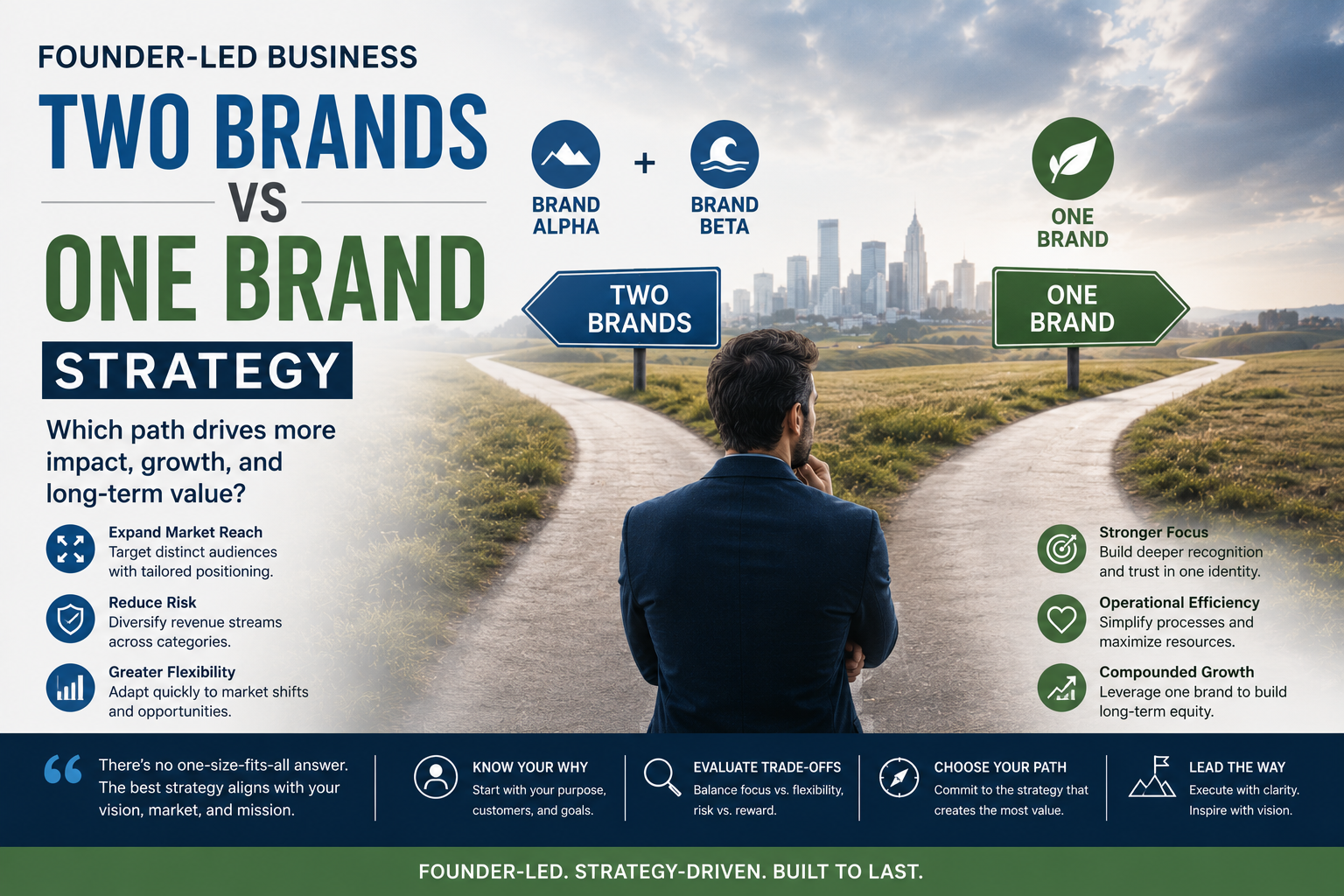
Founder-Led Business: Two Brands vs One Brand Strategy
A founder-led business often has a unique advantage compared to traditional companies: people trust people. Customers are naturally attracted to founders who share their knowledge, experience, and vision. A founder’s personality, expertise, and personal story can become a powerful marketing asset that helps a company build credibility faster and create stronger relationships with its audience.
However, as a founder-led business grows, one important strategic question often appears: should the company continue building one powerful brand, or should the founder create two separate brands for different products, services, or audiences?
The decision between a two-brand strategy vs one-brand strategy is much bigger than choosing different names, logos, or websites. It influences how customers perceive the business, how marketing resources are invested, how SEO authority is developed, and how easily the company can scale in the future.
Many founders believe that creating multiple brands automatically creates more growth opportunities. In reality, every additional brand requires significant investment, attention, and strategic management. A second brand without a clear purpose can divide resources, confuse customers, and weaken the original business.
The best approach depends on whether the different parts of the business share the same audience, customer needs, positioning, and long-term goals.
Understanding Brand Strategy in a Founder-Led Business
Brand strategy is the foundation that determines how a company presents itself to the market and how customers understand its value. For founder-led businesses, brand strategy becomes even more important because the founder’s personal reputation is often closely connected with the company’s success.
When deciding between one brand and two brands, founders are essentially choosing their brand architecture. Brand architecture defines how different products, services, and business divisions relate to each other.
A one-brand strategy means that the founder, company, products, and services operate under a single identity. Every marketing activity, customer interaction, and piece of content contributes to strengthening the same brand reputation.
A two-brand strategy means that the founder operates two separate identities. Each brand may have its own website, messaging, target audience, content strategy, and market positioning.
Neither approach is automatically better. The right choice depends on the relationship between the businesses. If both businesses serve similar customers and solve related problems, one brand is usually more effective. If they target completely different markets, two brands may create better clarity.
Why Most Founder-Led Businesses Should Start With One Brand
For most growing founder-led companies, building one strong brand is usually the smartest starting point. A brand becomes valuable through consistency and accumulated trust. Every article published, every customer review received, every social media interaction, and every recommendation contributes to the same business identity.
When a founder focuses on one brand, all marketing efforts work together. The company can develop a stronger reputation because customers repeatedly see the same message, values, and expertise across different channels.
This consistency is especially important for newer businesses. Early-stage companies usually have limited resources, and spreading attention across multiple brands can slow growth. Instead of building one recognized authority, the founder may end up managing several smaller brands that struggle to gain visibility.
A single brand also creates a clearer customer journey. People understand who the company is, what it offers, and why they should trust it. Strong positioning becomes easier because the company does not have to explain multiple identities to the market.
The SEO Advantages of Building One Strong Brand
Search engine optimization is another important factor when deciding between one brand and two brands. A single brand allows all website content, backlinks, mentions, and authority signals to strengthen one domain.
For example, imagine a founder owns a digital marketing company offering SEO services, content marketing, website optimization, and conversion strategy. These services may be different, but they all support one main goal: helping businesses grow online.
By publishing valuable content around these topics under one website, the company can build stronger topical authority. Search engines can better understand the company’s expertise, and users can discover multiple solutions from the same trusted source.
If the founder creates separate websites for every service, each website must independently build authority, create content, earn backlinks, and compete for rankings. This requires significantly more time and resources.
For this reason, many successful businesses prefer strengthening one powerful brand before expanding into additional brands.
The Business Benefits of a One-Brand Strategy
One of the biggest advantages of a one-brand strategy is stronger brand recognition. Customers are more likely to remember a company when they repeatedly see the same name, message, and identity.
A unified brand also makes marketing more efficient. The company can maintain one content strategy, one social media presence, one email audience, and one overall communication style. This reduces complexity and allows the team to focus on improving one customer experience.
Another major advantage is easier cross-selling. When customers already trust one part of the business, they are more willing to explore related services from the same company.
For example, a customer who hires a company for website development may later need SEO, content creation, or digital advertising. Under one brand, these services can be presented as connected solutions rather than separate businesses.
A strong one-brand strategy also helps create long-term brand equity. Instead of building several disconnected assets, the founder creates one valuable business identity that can continue growing over time.
When One Brand Strategy Becomes a Problem
Although one brand is often the best approach, there are situations where it becomes limiting. The biggest challenge appears when a company expands into markets that have completely different customers, expectations, or buying behaviors.
For example, a founder may operate a premium business consulting firm while also creating a low-cost online education platform. Both businesses may share the same founder, but the customers are looking for completely different experiences.
The consulting customer may value exclusivity, personalized service, strategic expertise, and professional credibility. The education customer may prioritize affordability, accessibility, and simple learning resources.
If both offers exist under the same brand, customers may become confused about what the company represents. Premium clients may question whether the business is specialized enough, while budget customers may feel disconnected from the brand’s positioning.
In situations where the audiences and expectations are significantly different, creating a separate brand can provide better clarity.
When a Two-Brand Strategy Makes Sense
A two-brand strategy works best when the businesses are different enough that one identity cannot communicate both effectively.
The most important reason to create another brand is a clear difference in audience, market position, or customer expectations.
For example, a founder may own an enterprise cybersecurity consulting company and a technology education website for beginners. Although both businesses are related to technology, they serve very different audiences.
Enterprise customers need professional expertise, security assurance, compliance knowledge, and business-level solutions. Beginner learners need simple explanations, affordable resources, and educational content.
Separate brands allow each business to create a message specifically designed for its audience. Customers can immediately understand the purpose of each brand without confusion.
A two-brand strategy can also be useful when businesses operate at different price levels. A premium service and a budget product may damage each other’s positioning if they exist under the same identity.
Premium brands depend heavily on trust, exclusivity, and perception. If customers associate the brand with low-cost alternatives, maintaining premium positioning becomes more difficult.
The Challenges of Managing Two Brands
While a two-brand strategy can provide advantages, it also creates additional challenges. Many founders underestimate how much effort is required to build and maintain another brand.
A second brand requires its own positioning, messaging, website strategy, content development, SEO plan, marketing campaigns, and customer communication process.
The challenge becomes even greater for founder-led businesses because the founder is often the main source of credibility. A founder who already manages operations, creates content, builds relationships, and leads strategy may struggle to maintain two different public identities.
Instead of creating more growth, the second brand can divide attention and reduce effectiveness.
Successful multi-brand companies usually have strong teams, clear systems, and enough resources to support each brand properly.
Founder Brand vs Business Brand
One of the most important decisions in a founder-led business is understanding the difference between a personal brand and a business brand.
A founder’s personal brand represents their expertise, opinions, experiences, and personality. It helps people connect with the individual behind the company.
A business brand represents the company’s products, services, systems, and customer experience. It helps the business create value beyond the founder.
The strongest founder-led companies use both strategically. The founder attracts attention and builds trust, while the company delivers consistent value through its products and services.
This balance is important because a business should eventually become independent from the founder. If customers only trust the founder and not the company itself, long-term growth and scalability become more difficult.
A successful founder-led strategy uses the founder’s reputation as a foundation while building a company that can operate beyond one individual.
The Hybrid Approach: A Balance Between One Brand and Two Brands
Not every situation requires choosing between complete integration and complete separation. Many businesses use a hybrid brand strategy.
A hybrid approach allows a new business line or product to have its own identity while remaining connected to the original company or founder.
For example, a founder may launch a specialized software product under a separate name but communicate that it was created by the established company. This allows the new brand to develop its own audience while benefiting from existing trust.
This approach is useful when a founder wants to test a new market before creating a completely independent company.
It provides flexibility while reducing some of the risks associated with launching a completely unknown brand.
How to Decide Between One Brand and Two Brands
The decision should always be based on strategy rather than excitement. Founders often create new brands because they have new ideas, but not every new idea requires a separate identity.
The first question to consider is whether both businesses serve the same type of customer. If the same audience can naturally benefit from both offers, keeping them together may be the better choice.
The second question is whether both businesses solve similar problems. Related solutions usually work better under one brand, while completely different problems may require separate identities.
The third question is whether customers will understand the relationship between the brands. If customers need a complicated explanation to understand why both businesses exist, the strategy may need more clarity.
Finally, founders should consider whether they have enough resources to support two brands properly. A second brand requires consistent investment, not just a new website and social media account.
Common Mistakes Founders Make When Creating Multiple Brands
One of the biggest mistakes founders make is creating additional brands too early. Building one successful brand requires time, consistency, and focus. Expanding before the first brand has strong foundations can slow overall growth.
Another common mistake is creating two brands that are too similar. If both brands target the same customers and communicate the same message, the company may simply compete with itself.
The purpose of multiple brands is not to create more names. The purpose is to create clearer value for different audiences.
A successful brand strategy should make the customer experience easier, not more complicated.
Final Thoughts: Should a Founder Choose One Brand or Two?
For most founder-led businesses, building one strong brand is the better starting point. A focused brand allows founders to concentrate marketing resources, develop stronger authority, improve SEO performance, and create deeper customer relationships.
A second brand should only be introduced when there is a clear strategic reason. This may include serving a completely different audience, protecting premium positioning, separating business risks, or preparing the company for future independence.
The goal is not to own more brands. The goal is to build brands that customers understand, trust, and remember.
The best founder-led companies use the founder’s reputation as a growth advantage while creating businesses that can eventually stand independently.
A simple rule can guide the decision: if all products and services support the same customer promise, build one powerful brand. If they serve different audiences, require different positioning, and have different long-term goals, a two-brand strategy may create stronger results.
The best brand strategy is not the one with more brands. It is the one that creates the most clarity, trust, and long-term business value.