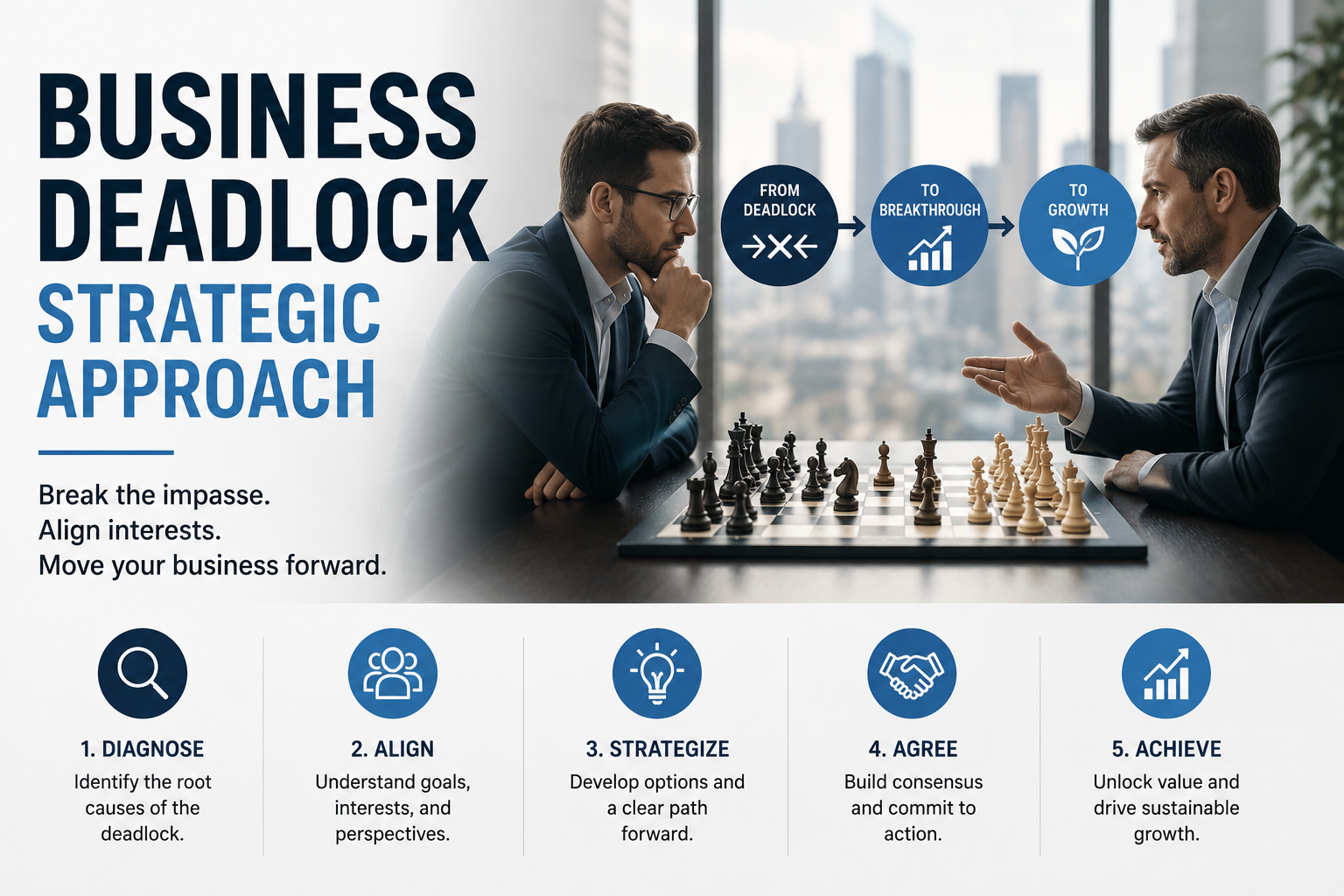
Every successful business faces moments when progress slows down. Sometimes, organizations experience situations where important decisions cannot be made, teams cannot agree on a direction, or existing strategies no longer produce the expected results. These situations are commonly known as business deadlocks.
A business deadlock can affect growth, productivity, innovation, and overall organizational performance. When leaders and teams remain stuck among options, opportunities may be lost, resources may be wasted, and internal conflicts can become harder to manage.
A strategic approach to business deadlock focuses on identifying the reasons for the blockage and creating a structured method to move the organization forward. Instead of making rushed decisions or allowing conflicts to continue, businesses can use strategic thinking, better communication, and data-driven analysis to find effective solutions.
Understanding how to recognize and overcome business deadlocks is an important skill for business leaders, managers, entrepreneurs, and professionals involved in strategic planning.
What Is a Business Deadlock?
A business deadlock occurs when an organization reaches a point where progress becomes difficult because decisions, actions, or agreements cannot be made.
In simple terms, a deadlock occurs when different people, departments, or stakeholders hold opposing views and no clear path exists to reach a decision.
For example, a company’s leadership team may disagree about whether to invest in a new market or focus on improving existing products. Both options may have advantages, but without a strategic decision-making process, the company may remain inactive while competitors move ahead.
Business deadlocks can occur at different levels of an organization. They may happen between executives, within teams, during negotiations, or when a company faces uncertainty about its future direction.
A deadlock does not always mean failure. In many cases, it indicates that an organization needs better information, improved communication, or a new strategic perspective.
Common Causes of Business Deadlock
Business deadlocks rarely occur due to a single issue. They usually develop because of multiple factors involving people, processes, and decision-making systems.
Conflicting Business Objectives
One of the most common causes of business deadlock is disagreement about priorities.
Different departments often have different goals. For example, a sales team may want to increase customer acquisition quickly, while the finance department may focus on reducing costs and improving profitability.
Both perspectives may be reasonable, but without alignment, the organization may struggle to decide which direction to follow.
A strategic approach helps businesses identify common objectives and create decisions that support the overall mission rather than individual department goals.
Lack of Clear Decision-Making Authority
Some organizations experience deadlocks because responsibility is unclear.
When multiple leaders have equal authority but no defined decision-making process, important choices can become delayed.
Clear leadership structures, accountability systems, and decision-making frameworks help prevent situations in which everyone has an opinion but nobody has the authority to move forward.
Limited Information or Uncertainty
Businesses often face deadlocks when they lack sufficient reliable information.
Leaders may hesitate to make decisions because they are uncertain about market conditions, financial outcomes, customer behavior, or potential risks.
In these situations, gathering better data and conducting proper analysis can help transform uncertainty into informed action.
Internal Conflicts and Communication Problems
Poor communication is another major reason businesses become stuck.
When teams do not openly discuss concerns, misunderstandings can increase. Employees may defend their own positions rather than working toward a shared solution.
Effective communication creates an environment where different perspectives can be evaluated objectively.
Market Changes and External Pressure
Sometimes deadlocks occur because external conditions change rapidly.
Economic uncertainty, new competitors, technological changes, or shifts in customer behavior can make existing strategies less effective.
Organizations must be willing to reassess their approach and adapt when circumstances change.
Understanding the Impact of Business Deadlocks
A prolonged business deadlock can create serious challenges for an organization.
One major impact is delayed decision-making. When companies cannot make timely decisions, they may miss valuable opportunities or lose competitive advantages.
Deadlocks can also reduce employee confidence. Teams may become frustrated when projects remain unresolved or leadership appears uncertain.
Financial performance can also suffer. Resources may continue being invested in ineffective strategies while important initiatives remain delayed.
For growing businesses, the ability to overcome deadlocks quickly can become a major competitive advantage.
Strategic Approaches to Overcome Business Deadlock
Resolving a business deadlock requires more than simply choosing one side of an argument. A successful approach involves understanding the situation, evaluating alternatives, and creating a clear path forward.
Analyze the Root Cause of the Deadlock
The first step in resolving a business deadlock is to identify the real reason for the problem.
Organizations should avoid treating only the visible disagreement. The deeper issue may involve unclear goals, poor processes, missing information, or leadership challenges.
A root cause analysis helps businesses understand what is preventing progress and what changes are necessary.
For example, if two departments disagree about resource allocation, the actual problem may not be the budget itself. It may be a lack of shared priorities or unclear business objectives.
Create a Shared Strategic Vision
A strong business strategy begins with a common understanding of where the organization wants to go.
When teams focus only on their individual interests, disagreements become harder to resolve. However, when everyone understands the larger business goal, finding solutions becomes easier.
Leadership teams should clearly communicate the company’s vision, priorities, and expected outcomes.
A shared direction helps stakeholders work together rather than compete.
Use Data-Driven Decision Making
Emotional decisions often contribute to business deadlocks.
Using reliable data allows organizations to evaluate options objectively. Market research, financial analysis, customer feedback, and performance metrics can provide valuable insights.
For example, instead of debating whether a new product idea will succeed, a company can analyze customer demand, competitor activity, and financial projections.
Data does not eliminate all uncertainty, but it provides a stronger foundation for strategic decisions.
Encourage Collaborative Problem Solving
Many deadlocks persist because people focus on winning arguments rather than solving problems.
A collaborative approach encourages stakeholders to explore different perspectives and find solutions that create value for everyone involved.
Effective collaboration requires active listening, respectful communication, and willingness to consider alternative viewpoints.
Leaders play an important role by creating an environment where employees feel comfortable sharing ideas and concerns.
Establish a Decision-Making Framework
Businesses can reduce future deadlocks by creating clear decision-making processes.
A decision framework defines:
- Who is responsible for decisions
- How information should be evaluated
- What factors should influence choices
- How disagreements should be handled
When employees understand how decisions are made, organizations can move faster and avoid unnecessary conflicts.
Consider External Expertise
Sometimes internal teams become too close to a problem and struggle to find new solutions.
External advisors, consultants, or industry experts can provide fresh perspectives and objective analysis.
An outside viewpoint can help identify opportunities, challenge assumptions, and recommend strategies that internal teams may overlook.
The Role of Leadership in Resolving Business Deadlocks
Leadership is one of the most important factors in overcoming organizational deadlocks.
Strong leaders do not ignore disagreements. Instead, they recognize them as opportunities to improve decision-making and strategy.
Effective leaders create clarity by defining priorities, encouraging communication, and making decisions when necessary.
A leader’s responsibility is not always to make everyone agree. Sometimes the goal is to create a fair process that allows the organization to move forward even when different opinions exist.
Good leadership balances different viewpoints while maintaining focus on business objectives.
Business Deadlock in Strategic Planning
Strategic planning is an area where deadlocks frequently occur because important decisions often involve uncertainty and risk.
Companies may struggle with questions such as whether to enter new markets, invest in technology, change pricing strategies, or restructure operations.
A strategic approach helps organizations evaluate these decisions systematically.
Instead of relying only on opinions, businesses can use tools such as market analysis, competitor research, financial forecasting, and scenario planning.
This creates a more structured environment for making complex decisions.
How Businesses Can Prevent Future Deadlocks
Preventing business deadlocks requires building strong organizational systems before problems occur.
Companies should encourage transparent communication, define leadership responsibilities, and regularly review business strategies.
Creating a culture where employees can discuss challenges openly helps identify problems before they become major obstacles.
Organizations should also invest in leadership development because managers who understand negotiation, communication, and strategic thinking are better equipped to handle complex situations.
Regular strategic reviews allow businesses to adjust their plans in response to changing market conditions rather than waiting until problems become serious.
Business Deadlock vs Business Conflict
Although business deadlock and business conflict are related, they are not exactly the same.
Business conflict refers to disagreements between individuals, teams, or stakeholders. Conflict can sometimes be productive because different opinions can lead to better ideas.
A business deadlock occurs when conflict prevents progress and halts decision-making.
A healthy organization does not try to eliminate all disagreements. Instead, it develops systems to manage disagreements effectively and prevent them from becoming obstacles.
The Importance of Strategic Flexibility
One of the most important lessons in business management is that strategies must adapt over time.
Organizations that become too attached to a specific approach may struggle when circumstances change.
Strategic flexibility allows businesses to review assumptions, consider new information, and adjust their direction when necessary.
Companies that remain flexible are usually better prepared to overcome challenges and take advantage of new opportunities.
Frequently Asked Questions About Business Deadlock Strategic Approach
What is a business deadlock?
A business deadlock is a situation where progress is blocked because decisions cannot be made, stakeholders disagree, or existing strategies are no longer effective.
How can businesses overcome deadlocks?
Businesses can overcome deadlocks by analyzing root causes, improving communication, using data-driven decisions, creating clear leadership structures, and developing strategic solutions.
Why do business deadlocks happen?
Business deadlocks often happen because of conflicting goals, unclear authority, poor communication, limited information, or changing market conditions.
What role does leadership play in resolving business deadlocks?
Leadership helps create clarity, manage disagreements, establish decision-making processes, and guide organizations toward effective solutions.
Can business deadlocks be beneficial?
Yes. A deadlock can reveal weaknesses in decision-making processes and encourage organizations to improve strategies, communication, and planning.
Conclusion
A business deadlock can slow down growth and create uncertainty, but it does not have to become a permanent obstacle. With the right strategic approach, organizations can analyze challenges, improve decision-making, and find practical solutions.
The key to overcoming business deadlocks is not simply making faster decisions. It is making better decisions based on clear goals, reliable information, collaboration, and effective leadership.
Businesses that develop strong problem-solving capabilities and strategic flexibility are better prepared to handle challenges and continue growing in competitive markets.