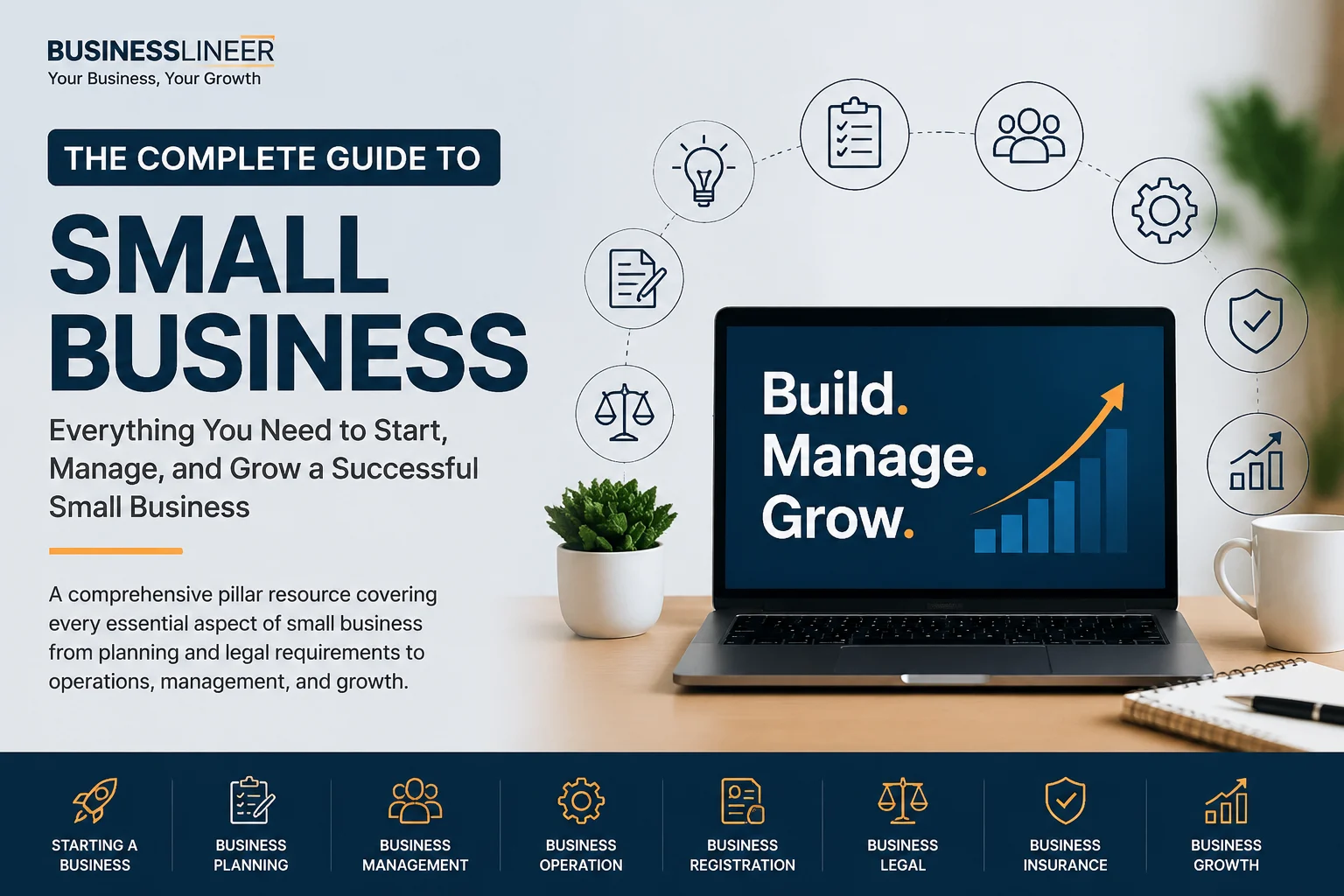
Creating a small business is rarely a straight line from idea to predictable success. It takes constant effort to understand and grasp a market, solve constraints, attract and draw customers, manage cash flow challenges and legal requirements, optimize operations every hour of every day you do business, isolate risk from your company, and pursue growth only where it matters. Someone thinking of becoming an entrepreneur will logically have questions that differ from those of someone who has already run a business for five years. Still, both are somehow part of the same small-business continuum. Understanding how each stage connects to the next can help you make more intentional business decisions and avoid problems that might arise later.
The first challenge for a new entrepreneur is whether an idea is commercially viable. A new business may focus on registration, pricing, bookkeeping, marketing, insurance, leads, and revenue. An existing business may try to recruit better employees, boost productivity, improve efficiency in Standard Operating Processes (SOPs), enter a new market or geography, or raise profitability while reducing the owner’s day-to-day involvement in decision-making. Thus, business success involves much more than learning how to start a small business.
A well-run business connects planning with management, operations with finance, marketing and sales with legal compliance, risk management and customer service, she says. One area of perceived weakness can cause trouble in another. A company may post sales that would make a sportsbook drool, but if its margins are weak or customers take too long to pay, it can still be in trouble. A separate company may have a great offering and lose clients because delivery lacks consistency. In fact, if revenue rises faster than the systems, workforce, and working capital that a rapidly growing company can sustain, that small business could become less stable.
This guide aims to give you a high-level understanding of the major pillars of starting, running, securing, and growing your small business. It is designed to serve as a central hub that links to the various aspects of business ownership while guiding you to more detailed information where specific topics merit greater focus. Because business registration, taxation, employment, licensing, insurance, and legal obligations vary by country/state/province/municipality/industry/type of organisation, we advise you to always check requirements in your jurisdiction with competent authorities and qualified professionals.
What Is a Small Business?
A small enterprise is typically defined as an independently owned and operated company that is smaller than a large corporation in terms of revenue, number of employees, market, or organisational sophistication. The practical sense is simple, while official definitions can be more complex. Different sectors use different measures to determine whether a company is small; authorities, lenders, tax authorities, procurement programmes, and regulators will use very different requirements.
However, the tell-tale issue for business owners is generally: how does small business scale integrate with everyday decision-making? By definition, small businesses are less likely to have as much cash available as a backup as larger companies and have smaller teams in place (and less specialisation). An owner may be doing strategy in the a.m., customer complaints in the p.m., and invoices at night. That concentration can make small businesses nimble and responsive but, on the other hand, can also make them overly reliant on one or two magical people.
This blend of nimbleness and fragility is a hallmark of small-business ownership. Changing prices, launching a service, or responding to customer feedback can take a day for a small company versus possibly years for a corporate one. However, losing one key customer, employee, supplier, or asset can matter a lot more. The key to managing a small business successfully, then, is holding on to the speed and intimacy of a small business while slowly building better processes, financial controls, systems, and risk protection.
A third thing to realize is that small businesses are not all the same. The small-business world includes everything from a local restaurant, independent consulting firm, e-commerce company, construction contractor, software startup (how to start software development), manufacturer, professional practice, and family-owned retailer—each with vastly different operating models. This is why business advice should always be contextualised to a company’s industry, maturity stage, customers, available resources, and objectives, rather than treated as a one-size-fits-all cutout.
Understanding the Small-Business Lifecycle
Although the timing and order vary, most small businesses typically go through a few familiar stages. The first stage is exploration, when an entrepreneur discovers something worth investigating — a potential opportunity that may be a customer problem, market need, product, service, or business model. At this stage, what the company looks like formally does not matter yet; it is about curiosity and research, because the central question is whether a commercial opportunity really exists.
Next comes the verification and planning stage. The entrepreneur starts researching customers – potential customers, competitors, price and cost structure, market size, demand landscape, need for funding or capital requisites, as well as elements operationally needed to get this plan to fruition, while also anticipating all risks that may lead to failure. Assumptions should start to be supported by evidence at this point. A good idea becomes more valuable when potential customers indicate a willingness to purchase the product, rather than merely saying they like the idea.
When the company is ready for more formal operation, it moves into formation and launchfollow-up. This decision depends on jurisdiction and business type. Still, it can include choosing a business structure, registering your business, applying for tax identification, obtaining licenses or permits, opening business bank accounts, acquiring insurance to run the firm safely, and bookkeeping transactions while starting sales activities. These steps lay the groundwork for administration (as opposed to management, which needs to be built around a business). Still, they will only serve as a foundation if they precede market validation.
After the business is operational, the owner becomes focused on management and implementation. You must have repeatable sales, continuously serve your customers, monitor spending, ensure vendors perform, manage and motivate employees, and keep company records accurate. If the informal approaches that helped in these initial days start to become erratic once customers and organisational complexity increase,
Some companies then enter a growth stage, where they expand their customer base, workforce, product range, number of locations or markets, and partnerships, and invest in technology or production capacity. You are exposed to more opportunity – as growth always is – but new risks too, for with increased revenue generally comes greater headcount, stock inventory, supporting infrastructure, systems and working capital. Then, as firms become larger, they will need to think about succession, or hope to sell, merge or restructure, meaning that all businesses need an exit plan sooner or later. This matters because a business’s top priority changes by stage.
Starting a Business: Turn an Idea Into a Real Opportunity
A good business starts with customers or the market, not paperwork. Registering a company makes it legally recognized, but registration doesn’t guarantee customers want what you plan to sell. The entrepreneur should know who the customer is, what problem they’re trying to solve, how that problem is already solved, and how you can offer a better solution before investing heavily in branding, inventory, equipment, office space, software, or hiring employees.
The first and most practical step is defining the customer as narrowly as you can. When a product is marketed to “all,” it often complicates business decisions — customers have different priorities, budgets, buying habits, and expectations. A company selling bookkeeping services to freelancers, for instance, will likely sell and service that offering differently than a company servicing restaurants or manufacturing. A customer definition makes it easier to craft a relevant offer.
Validation is the next step. Validation may include conversations with future customers, small paid tests, pre-orders, prototypes, minimal services, pilot programs, or landing pages where a potential customer can click for a demo or an example of how it works—testing whether anyone will actually pay and hand over the solution. The goal is not to convince you that every individual wants the idea. The purpose is to gather enough data to assess whether a significant market of customers has a case to buy.
Competition: Entrepreneurs should study competition carefully. Competition is not just other companies with the same product. They may take matters into their own hands, enlist a substitute vendor, throw good money after bad with an existing supplier, delay action until a future date, or do nothing at all. Knowing these alternatives helps a business develop a more compelling value prop because it requires the entrepreneur to explain why switching from the existing solution is worth it.
The financial aspect of the idea is also equally important. As well, a business model must generate enough revenue and margin to fully fund the cost of creating the product or delivering the service, attract customers, run and operate an organization (pay employees/contractors, pay taxes, maintain technology/infrastructure needed for delivery and operation of the business), everything it takes to buy-in customers (including marketing costs), insurance, etc. If each sale produces an insufficient margin or needs expensive onward support, a company can appear to have great sales numbers but be economically weak.
Most entrepreneurs are better off starting a reasonable version of the business and waiting on the highly complicated version. For example, a consultant may start with one specific offer for one particular target market. For example, an online-only store may test a small subset of products before stocking hundreds. An application company might nail the most important customer problem before adding a long list of capabilities. This narrowly scoped model gives the company a chance to observe real consumer behavior before spending millions of dollars and months on it.
Data should come from every early transaction. Customers tell you which benefits are important, what objections keep them from buying, what questions they ask the most, where in your service creates frustration, and why someone buys one solution over another. Entrepreneurs who consistently capture this information can hone their position, price, product, and operations much faster than those who still depend on assumptions. If you are preparing for your launch, readers can check out the Starting a Business section of Businesslineer for deeper insights on business ideas, validation, startup costs, and early-stage funding decisions.
Business Planning: Turn an Idea Into a Workable Direction
Business planning gives a company direction before day-to-day realities dictate what happens next. According to the U.S. Small Business Administration, a business plan is a roadmap for how it will be structured and run — and how it will grow. A useful plan doesn’t have to be a tiresome document with over-the-top specifications; it should push the owner to think through the assumptions underpinning the company.
The level of detail should correspond to the plan’s objective. For a self-funded service business testing its first customers, the working plan might be short and simple, amounting to just a few paragraphs outlining customer, service, price, cost, marketing strategy, and immediate goals. A company applying for significant financing or outside investors should typically present more comprehensive market research, financial projections, management information, risk analysis, and documentation of assumptions.
A business plan basically needs to define what the company sells, who its customer is, what problem it solves, why customers will buy it, how the business will reach those customers (e.g. direct sales or online) and move product or deliver services as well as what resources are needed to operate; ancillary processes like accounting; how revenue is generated and which risks threaten success of this plan. This template runs on its most important variables—sensibly answering these questions is far more useful than just filling out a template.
Separating fact from forecast is also part of strong planning. This is factual information an owner can verify, such as whether a supplier has provided a price in writing. So your plan says, in Q1 we expect 1,000 purchases — that is a testable forecast. If those assumptions are clearly stated, management can compare actual performance to these expectations and make adjustments when reality and expectations diverge.
Planning finances should be an integral part of the process. They should determine how much it costs to get the business started, fixed expenses each month, variable expenses each month, projected sales over the next several years, what percentage of revenue gets you to break even over time (aka gross margin), how many new hires will be needed, and what sort of working capital is available with a limit on sustainability after a set period. Cash flow is critical because even a profitable company can stumble financially if cash leaves the business before customer payments clear.
Forecasts can be far more useful with scenario planning. Forget everything going well once; even if I really want to think sales come in more slowly than expected, prices based on supplier costs go up, and a big customer pays after a few months, whether it takes less time or another ad-paid aggregator will be reviewed as maturation pay at the bad moment. This is not an attempt to forecast every possible scenario. Ultimately, it identifies the key assumptions and how much leeway the business has to adapt to changing circumstances.
Your business plan must grow, too. One of the best and least effective methods is developing a plan related to a bank, investor, or school assignment and then never looking at it again. Have a working plan, and measure actual performance against it. If one set of customers responds much better than expected, you can rethink where to spend your time. If acquisition cost is very high, the marketing strategy needs to be altered. Consider reviewing pricing or costs when a product has high sales but low margins.
In this context, planning is thus better seen as an iterative cycle of plan, do, measure, learn, and adjust. It uses market information to make better decisions, and does not treat the original plan as fixed. Businesslineer Business Planning resources explore business models, market research, competitive analysis, financial forecasts, strategic planning, and formal business-plan development in detail.
Business Registration: Create the Proper Business Foundation
Preparing to register and form as an operating company in the right location. Requirements vary significantly by location, business type, and ownership structure. For instance, the US Small Business Administration explains that an organisation’s structure influences not just taxation, but also potential personal liabilities, capital-raising and administrative responsibilities. Other countries use entirely different frameworks and registration systems, so entrepreneurs should check the specific rules for where they plan to start up.
Don’t treat business structure as a clerical decision. Common forms are sole proprietorships, partnerships, limited-liability entities (LLCs and LLPs), and corporations. Your decision will depend on the number of owners, risk exposure, tax treatment, administrative costs, financing plans for growth, management arrangements (to act as business or owner), continuity, and long-term objectives.
The easiest or least expensive way to build is not always the best long-term path for a company. Your needs for a one-person consulting business differ greatly from those of a company with multiple founders, outside investors, employees, intellectual property, something of value, or major exposure through contracts. Professional advice lets owners know the tradeoffs an owner will make before committing to a structure when financial or legal consequences are significant,
This may also go beyond simply registering the primary business conduct. Depending on the jurisdiction and activity, requirements may include a registered business name, tax identification number, sales-tax or value-added-tax registration, employer registration, professional licenses (for doctors), industry permits (for restaurants), building zoning approval, local business licenses, and company authorization. Some requirements apply before you start trading. In contrast, others trigger when you hire employees, reach a specific revenue level, sell particular products or services (regulated business), or move into another jurisdiction.
Owners should not assume compliance ends with one registration. Businesses evolve, and so do their requirements. Hiring a first employee or freelance worker, expanding an online business into another tax jurisdiction, or opening another physical location for a retailer could create new obligations that may not have existed at launch. A compliance calendar and regular reviews of official government guidance can help ensure you don’t miss filings or renewals.
This should commence at the same time as good recordkeeping. Organise your formation documentation, tax registration information, ownership records, licenses and permits, agreements, renewals and important correspondence in an orderly manner. This documentation can help when the business later seeks financing, changes ownership, enters contracts, or gears up for sale. Check the Business Registration section on Businesslineer for a more in-depth look at business structures, entity formation, names, tax identifiers, issuance of licenses and permits, and other registration-related decisions.
Business Legal: Protect the Company Through Better Legal Awareness
More: Small-business owners run into legal problems a lot sooner than many realize. Legal obligations can come from contracts, leases, customer terms, supplier agreements, intellectual property, advertising regulations, employment relationships, privacy, debt ownership and control, streamlining operations, and scope-driven taxation. Some decisions don’t require a lawyer, but ignoring legal implications just because the company is small still creates risk.
Some of the simplest routines involve documenting essential business relationships. Informal agreements may work when expectations align, but disagreements often start when people remember promises differently. It helps spell out what you will deliver, for what price (or in what manner), when payment is due, who owes specific duties; how any required changes are to be taken care of; who owns the finished work; a party termination of their relationship by either performer requiring compensation or refunding a portion of expected fees if close to agreement deadlines and how to deal with conflicts.
You focus on agreements between founders in particular. You should know about ownership percentages, voting rights, compensation, responsibilities, capital contributions, intellectual-property ownership, and decision-making authority between partners, including ownership transfers and what happens if one person wants to leave or has to leave. Addressing these issues before a dispute arises can safeguard the business and the personal relationships between partners.
If your business is based around real estate or creative content, consider intellectual property as it can be quite valuable. Owners must know what protections are available in their jurisdiction and when trademarks, copyrights, patents, confidentiality agreements, or other mechanisms are most appropriate. The degree of protection needed should match the creation’s commercial value and how likely it is to be used inaccurately.
In an age when most small businesses collect customer, employee, and payment information through websites or apps and store it in cloud systems like AWS or third-party platforms, privacy & data protection become a constant concern. Legal obligations vary depending on the type of information collected, where your customers are located, how you use their information, and which regulations apply. Collect only what you need; understand how key information will be stored, accessed, shared, and secured.
Compliance also continues after formation. Licenses expire, tax obligations vary, employment contracts grow, and contracts need renewal. Different requirements can stem from a new product, location, employee and customer type, or international market. Legal compliance for small businesses should not be a one-off task to check at startup; it should be integrated into everyday management through calendars, written roles and responsibilities, professional legal advice when appropriate (including contract reviews), and reliable record keeping.
Given the financial exposure of legal matters, a qualified professional in the relevant jurisdiction should review high-risk decisions. The Legal section of Businesslineer can offer comprehensive educational guidance on contracts, business ownership, compliance, intellectual property, liability, and employment considerations your new business may face—as well as other legal issues businesses frequently encounter.
Business Insurance: Protect the Company From Risks It Cannot Afford to Absorb
Every business carries some risk, but the owner does not have to shoulder every potential financial loss. Insurance transfers certain risks to an insurer in exchange for premiums; UM and UIM apply only subject to the policy’s limits, exclusions, deductibles, conditions, and terms. Making sure that you have the right insurance strategy is less about unthinkingly buying whatever small business insurance policies are promoted than making sure that they cover your company’s actual exposures.
The risks for a consultant with a laptop working from home are very different from those of a restaurant, manufacturer, builder, shopkeeper, professional in a practice setting employing people, or even a large employer! Potential coverage could include, but is not limited to, general liability, commercial property insurance, professional liability, product liability, workers’ comp, commercial vehicle insurance, and others such as cyber coverage, business interruption protection, and unique policies tailored to your field.
So, the most important question to get started with is NOT what insurance do most businesses purchase. Instead, owners should consider what trigger events would have to occur for a loss of this amount to take the company down. Injuries or damages, lawsuits, professionalism errors, thieves, fire, equipment failure, cyber events/property damage OR interruption of operation (due to injuries or damages as a result of malfunctions).
Improved procedures can reduce some exposures rather than relying only on insurance, by reducing risk through safety training, quality controls, rigorous contracts, cybersecurity protocols, equipment maintenance, and employee screening. Other risks may be small enough that the company can absorb them affordably. The biggest exposures you could ever face are typically ones that warrant a discussion with an insured.
Insurance requirements can also come from other sources. Some coverage may be mandated by law, while other policies or limits may be required by a landlord, lender, client, professional organization, or commercial contract. Because these requirements vary widely by jurisdiction and industry, we encourage owners to confirm what applies rather than opening the relief in general.
Insurance policies also need periodic revisions. When a business hires employees, opens a location, buys equipment, increases inventory, develops new services, collects more customer data, buys vehicles, or enters into bigger contracts, the risk profile changes. The policy that was right for the company in Year 1 may not be adequate coverage 5-10 years down the line. Businesslineer includes resources to help readers understand key coverages, assess industry risk, consider policy options, and ask licensed agents the right questions.
Business Management: Turn Individual Effort Into an Organized Company
Building a company is more of an entrepreneurial challenge, but running one is more obviously organizational. As customers, employees, and responsibilities grow, success becomes less about what the owner does themselves (or how hard they work), and more about whether people can make good decisions and coordinate well. Business management means persuading people to focus on what matters, directing resources, bringing in fired-up talent, clarifying intent and direction, tracking results, providing counsel when needed (and when not), nurturing staff development and upward mobility, balancing books and accounts, and channeling ownership.
Small businesses often end up in this situation because too many priorities surface at once. The owner wants more sales, fewer expenses, better customer service, new products, enhanced systems, and improved marketing all at the same time. When everything becomes urgent, employees receive mixed signals, and the owner often becomes a bottleneck. In each period, this means picking a small subset of the most important objectives and making it easier to align resources with the work that actually improves the company.
Performance measurements should support those decisions. A service company might track qualified leads, sales conversion rates, project margins, customer retention metrics, utilization rates, and collection time. A retailer may prioritize gross margin heavily over inventory turnover, average transaction value, stockouts, or repeat purchases. The exact metrics vary by business model, but the underlying principle is the same: get data that helps management pinpoint trouble spots and take more informed decisions.
As the business grows, delegation only matters more and more. At some point, most founders approve every payment, talk to every key customer, memorize every process, and make every important decision. That may be inevitable at the very outset, but over time it restricts scale. It is limited to the number of decisions that the owner can handle themselves
Delegation has little to do with handing things off to someone else. Employees do better when they know the required result, the limits of their authority, the standards that apply, the resources available, and when a decision needs to be escalated. Process documentation thereby eliminates the reliance on memory. The business should still be clear on how critical work is performed, even if the key employee is unavailable.
Don’t hire just because you feel busy; hire against clear business requirements. In some cases, a company needs to grow because existing workers cannot accommodate the demand. In other situations, it lacks a specific capability, such as sales acumen, financial oversight, operational leadership, technology skills, or customer service expertise. By defining the business problem first, it becomes clearer whether the need is a full-time hire, part-time worker, contractor, consultant, or outside service provider.
Financial management also comes within management. Revenue garners attention because it proxies demand. At the same time, profit makes the newspaper thanks to being an abstraction of economic performance — but cash determines whether bills can actually be paid when they come due. Owners should be consistently monitoring cash balances, receivables, payables, payroll and tax obligations, debt repayments actioned from operating cash flow (on time) (overspending their operating budget), cash commitments for inventory purchases, asset additions or other large-scale expenses planned but not yet incurred. These decisions become a lot more manageable with sound bookkeeping and reliable financial reporting.
While the business owner may not personally perform every accounting function, they must understand what the relevant financial information means for the company. Managing the organization means knowing whether margins are improving, expenses are rising, customers are paying slowly, or debt obligations are about to become a problem. For readers seeking more comprehensive advice on leadership, staffing, decision-making, productivity, workplace systems, and organizational development, head to Businesslineer’s Business Management section.
Business Operations: Build Reliable Systems for Everyday Work
Business management sets objectives and the course of action, and business operations translates them into repeatable execution. Operations include everything from people and workflows to technology, suppliers, equipment, facilities, inventory, quality controls, and systems that enable a company to provide products and services consistently over time. Good operations are often hidden because if the customer never sees anything wrong, they experience an organization that functions as it should.
Weak operations become visible quickly. Deliveries are late, invoices are filed incorrectly, staff may use different procedures to complete their assignments, inventory goes missing for no good reason, customer requests get lost in the shuffle, and the owner finds themself busy fighting fires all day long. Variations of these problems are often laid at the feet of employees, but that is unfair when they have never been given a chance to run a process that was never configured properly in the first place.
Process documentation should NOT get complicated. Base it on activities that are high frequency, high value, non-trivial to train/teach, and lead to common errors or decisions driven by one person´s knowledge. For example, a service company can document client onboarding, the quotation stage, scheduling, project delivery, invoicing, and more, like complaint handling and project closure. If you were a retailer, you might focus on receiving inventory, managing in-store stock, processing customer returns, handling cash receipts, performing opening and closing procedures at specific times of day, or ordering products from suppliers.
Typically, it lays out what should happen, who does it, what information or tools you need, standard operating procedures, how quality is checked, and what action or result occurs when the process deviates. Treat processes as permanent and improve them iteratively as well. Because much of this content is treated as permanent, we learn by doing better than before, which is obvious. Employees doing the work often know where unnecessary steps, delays, or errors occur, so operational improvement should leverage their experience.
Before asking everyone to speed up, find the bottlenecks that slow the business down. Does every owner need to approve every quote? Perhaps one employee does something important that no one else knows how to do. Production may be limited by equipment availability, or workers may enter the same data multiple times in different systems. Identifying where the constraint lies helps because overcoming it improves overall performance more than randomly trying to do more everywhere else.
Another domain that comes under operational responsibility is supplier management. The best suppliers can impact cost, product quality, delivery speed, and even customer satisfaction by having the right products available when needed. Businesses must know which vendors matter and what might happen if one suddenly raised prices, went down during an outage, drastically altered payment terms, delivered late, or ceased operating. Where possible, assess alternatives before an emergency.
Tech can improve how operations run, but more software does not make a business better. The tools and processes you introduce must reduce meaningful work, lower error rates, increase visibility, enhance customer experience, or deliver capabilities that would otherwise be difficult to achieve. For example, a company relying on ten poorly functioning, disparate applications may create more administrative work than one that uses fewer but more tightly integrated systems.
Cybersecurity must also be integral to operations. Phishing, ransomware, data theft, account compromise: all small-business-sized threats independent of the resilience of their systems architect—the U.S. Good password hygiene, multifactor authentication, routine software updates and patching, proper access controls, consistent backup protocols, employee training, and logical vendor management help reduce risk.
Operational resilience is equally important. Business owners should ask themselves what would keep them from serving customers tomorrow. Your ability to conduct business may be severely disrupted by an internet outage, a damaged facility, a cyberattack that prevents access to supplier resources and processes, an unavailable supplier, major equipment malfunction, a hostile weather event, or loss of urgent access to key records. While you can never prevent every event, an effective backup system, emergency contacts, contingency and/or alternate suppliers, alternative producers with documented procedures to get things done, and contingency plans during a crisis; insurance information for property or your area of business operations, including options for communication in the event of disaster recovery greatly enhance survival.
Operations should not turn a small company into a bureaucratic one. You want enough structure in place for customers to keep getting consistent value, but you don’t want the owner running every detail of every customer engagement. The Business Operations section of Businesslineer can provide in-depth guidance on workflows, systems, productivity, supply chains, technology, process improvement, and day-to-day execution.
Business Growth: Expand Without Damaging What Already Works
Growth is marketed as the built-in goal of every business, but growing revenue does not necessarily make a company better. One way to double sales is to shrink profits, burn people out, take on more debt, get credit ratings downgraded, cut customer experience, and put pressure on cash flow. More long-term value and resiliency come from healthy growth (not just bigger).
This leads to the first growth question a company should ask itself: what does it want to grow, and why? Some businesses want to be more profitable and more economical, achieving higher profits without increasing headcount. Others want more locations, increased market share, a wider product portfolio, geographic diversity, recurring revenue, or a business they can later divest. The growth strategy has to align with the owner’s goals and, importantly, the business economics.
Management should understand the consistency of the current model before expanding aggressively. What are your products or services that have a healthy margin? Which customers are most valuable? What marketing channels are consistently good at producing customers? Where does this current operation start to reach capacity? What breaks when sales increase? If these questions cannot be answered already, growth could expose cracks that were previously present and magnify weaknesses in certain areas.
Customer retention deserves particular attention. Most businesses focus on acquiring new customers, but repeat customers can make growth more efficient and predictable. Why do customers return, and why do they leave? Management should know which complaints recur and which elements of the experience build loyalty. High retention can show that the company delivers value, whereas constantly replacing dissatisfied customers can mask bigger issues.
Expansion can also create a surprising level of cash stress. A business may need to buy inventory, ramp up advertising, hire workers, move into a larger space, buy equipment, and fund receivables long before revenue hits the bank account. Hence, growth plans should model not only expected profit but also when cash will be needed.
Retained earnings, owner capital, loans, business investors, strategic partners, customers, or other sources of funds can all finance growth. Again, those are different costs and consequences. Disadvantages of these strategies include: Debt needs to be repaid; external investors dilute ownership stakes; and self-financing can stunt expansion. This depends on the company’s health, risk-taking capability, growth opportunity, and long-term vision.
There are many other mechanisms through which businesses can grow. A local industrial business may become a multi-branch operation, and a professional-services firm can grow by adding new specialists or creating permanent products. A manufacturer can expand into another geographic market. For example, an online business could expand its product lines with related products. Other companies can also expand through joint ventures, licensing, franchising, and acquisitions, as well as exports and government contracts.
No matter what path is taken, organizational structure will ultimately need to evolve with the business. More staff bring even greater demands for communication and management. This is true as more customers bring more support requests and exceptions. More locations create coordination challenges. Adding more products adds complexity to inventory, purchasing, marketing, and reporting. Systems that seemed superfluous for the small company may have become the organization’s lifeblood.
This doesn’t mean bringing in bureaucracy just because the company has grown. Ideally, you want to keep the valuable speed a startup brings and add enough clarity and control so chaos doesn’t reign. As the company matures, you may rely more on financial reporting, documented procedures, management roles, forecasting, HR processes, customer systems, and more—cybersecurity, legal reviews, and quality controls come into play. The Business Growth section of Businesslineer offers deeper insights into scaling, expansion, growth financing, partnerships and acquisitions, new markets, and organizational development.
The Business Systems That Connect Every Stage
Starting, conceiving, registering, and administering a business go hand in hand with running it, venturing in it, and expanding. Many key systems affect every stage, even if not specifically considered a stand-alone small-business sub-category. The six most important are finance and accounting, marketing and sales, people, technology, and risk management.
Finance informs us only whether the business activity is creating economic value. Owners should understand revenue, expenses, gross profit, operating profit, cash flow (when to invest and when to hold back), assets, liabilities, and accounts receivable & payable at a level appropriate to their company. Dependable accounting might show that a chapter eight product has thin margins, that one customer population group pays too slowly, or that stock is sucking up too much cash. The overhead fees are increasing faster than revenue.
Biz dev and sales create demand so you can scale the business. An owner should know how customers find the business, which channels create qualified demand, the path to purchase for prospects, and what drives repeat purchases. As the business grows, this concentration risk can matter if you become overly dependent on a single advertising platform, referral partner, or big customer, and you have to consider how to diversify away from them.
People connect strategy with execution. Employees need unambiguous roles, expectations, training, feedback, and the right level of power. Culture is what the company rewards again and again, tolerates, encourages, and discourages—not necessarily what values are written on its website. A company seeking accountability must clarify roles and follow up on repeated failures, not simply establish accountability as an organizational principle.
The information and technology we provide affect how quickly management can understand the company as a whole. Owners should not need to spend hours piecing together their numbers to answer operational or financial questions. Sales, cash position, items owed to the business, stock information (Inventory), client retention performance, overdue labour, and marketing performance, among other things, should become more visible as the company continues to grow.
Risk management ties them all together. There are many ways to decrease risk without insurance, such as cash reserves, service providers with diverse locations, contracts and arrangements (e.g., real estate), cybersecurity specification implementation/training and enforcement, workforce training/enforcement of labor laws & rules or quality assurance measures, reward plans for employees adhering to general policies further decreasing risk through integration into the culture of your company, etc. One management exercise is to flag the events that can do the most damage to the business, then determine what preventative or protective measures are feasible.
Common Small-Business Mistakes
Small businesses fail for many reasons, and no single checklist can answer it all. Still, patterns emerge frequently enough to warrant consideration. One is mistaking a personal urge for market acceptance. Founders can be passionate entrepreneurs, absolutely convinced of the value their idea provides even when customers refuse to pay for it.
Underpricing is another common problem. At times, owners set prices based on what seems affordable instead of calculating the total cost of delivering the product or service. The business case also needs to account for direct labor, software, insurance, advertising, management time, payment fees, returns & taxes, and supporting administrative work, equipment, and overhead.
Another loophole comes from rapid growth. Revenues rise, but margins fall; cash flows become a tighter fight, like King Kong vs. Godzilla. Higher-growth companies can become more brittle than successful when they hire too early, buy excess stock, add locations before the first one is performing well, or increase marketing without understanding customer economics.
Founder dependence is another risk. If each critical decision, customer relationship, supplier negotiation, password—in fact, any approval or process—rests with one person, the business will have extremely limited capacity and resilience. Gradually transfer key knowledge from individual brain to systems that other capable people can follow and use.
High divergence in financial data causes other issues. Without dependable information, owners will be in the dark about which products generate profit, how much customers owe, which expenses are rising, what taxes loom, and whether company cash will easily cover future payouts. Keeping accurate books should be an operating requirement, not an administrative burden—then financial management becomes much easier.
The other mistake is to adapt too late. Owners become attached to products, processes, employees, locations, pricing methods, or marketing channels that helped form and grow the business. However, markets change. Customer preferences change, new competitors arise, costs rise, technology advances, and regulations evolve. Resilient companies stick to their core mission but change how they achieve it when data shows what used to work no longer does.
How to Build a Small Business That Can Last
No successful business is built on a single brilliant decision. It is cultivated with hundreds of smaller decisions, made repeatedly over time. Owners with a clear focus improve customer management, pricing, hiring, and cash flow; they hire slowly, execute documented processes, monitor and listen for risks, internalize feedback, and research competitors before changing lanes based on evidence.
One of the most valuable habits is stepping back from operating the company every so often to reflect on it as an exec. Responding to messages, troubleshooting customer issues, approving purchases, answering employee questions, and dealing with emergencies can easily fill a business owner’s day. These tasks may be necessary, but keeping activity high can mask whether the company itself is improving.
Ask what is driving stronger or weaker margins, which customer groups are most profitable, where employees lose time, which processes keep going wrong, what relies too much on a single person being there, where risks have gone up, and where money could be invested for the highest returns. It is also important to ask what the company should stop doing. Everything can be a resource sucker — products, services, meetings, reports, systems, customers and processes.
A strong small business gets easier to understand and run the larger it becomes. The right things become visible, accountability starts to occur, customers get a more consistent experience, and the owner can focus on longer-horizon trade-offs instead of constantly dealing with every operational detail. This doesn’t happen naturally. This comes from conscious strategy, governance, instrumentation, and financial discipline.
Small Business FAQs
What is the first step in starting a small business?
The first step is usually identifying a real customer problem or market demand and gathering evidence that people will pay for a solution. Registration, branding, financing, websites, and other startup tasks matter later, but validating the opportunity first can prevent you from investing heavily in a business that doesn’t have enough demand.
Do I need a business plan for a small business?
Most businesses benefit from some form of business planning, although the plan does not need to be unnecessarily long. It should help you understand your customer, offering, market, competition, revenue model, costs, operations, risks, financial requirements, and goals. Businesses seeking outside funding will generally require more detailed financial projections and supporting evidence than a simple self-funded business.
When should I register my business?
The correct timing depends on your jurisdiction, business structure, activities, and applicable regulations. Before you begin operations, determine which entity registration, business-name filings, tax identification, licenses, permits, and employer registrations you may need. Use official government sources to verify the requirements for your situation.
Which business structure is best for a small business?
No single structure is best for every small business. The appropriate option depends on factors such as ownership, taxation, personal liability, administrative obligations, financing plans, future investors, and long-term objectives. When the legal or financial consequences are significant, a qualified attorney or tax professional can help explain the available options.
Does a small business need insurance?
Many businesses benefit from insurance, and certain types of coverage may be legally or contractually required. The right policies depend on the company’s employees, products, professional services, equipment, property, vehicles, customer data, contractual obligations, and other exposures. A business should identify risks that could create losses it cannot comfortably absorb and discuss appropriate coverage with a qualified insurance professional.
What is the difference between business management and business operations?
Business management focuses on direction, priorities, decisions, people, resources, performance, and leadership. Business operations focus more closely on how work is actually completed through processes, systems, technology, suppliers, inventory, facilities, and workflows. The two areas are closely connected because management decisions determine how operations should perform, while operational results provide information that management uses to make further decisions.
When is a small business ready to grow?
A company is generally better positioned for growth when it has evidence of repeatable demand, healthy economics, sufficient operational capacity, financial visibility, appropriate management capability, and a realistic plan for financing expansion. Growth should strengthen the business, not just increase sales. If the existing operation is already unstable, additional volume can magnify problems instead of solving them.
How can a small business improve profitability?
Profitability can improve through better pricing, stronger product selection, lower waste, more efficient purchasing, improved productivity, increased customer retention, stronger marketing, better capacity utilization, and disciplined control of overhead. The best starting point is usually understanding where the company currently earns and loses money rather than reducing expenses indiscriminately.
Why is cash flow so important for small businesses?
Cash flow determines whether the company can meet financial obligations when they become due. A business can show an accounting profit while still experiencing cash pressure because customers pay slowly, inventory must be purchased in advance, debt payments are due, taxes accumulate, or growth requires additional working capital. Owners should therefore monitor cash flow alongside revenue and profitability.
How often should a business plan be updated?
Review a business plan whenever key assumptions or conditions change, and periodically compare it with actual performance. New products, locations, employees, financing, regulations, competitors, customer behavior, costs, and growth opportunities can all justify updates. The plan is most useful when it functions as a living management tool rather than a document created once and forgotten.
Building Your Small Business One Stage at a Time
A small business that succeeds knows it doesn’t need to solve every future problem in its first year. It needs to fix the right issues at just the right time. First-time entrepreneurs need to focus on understanding customers and validating demand. A startup should set up appropriate registrations, planning, finance systems, legal awareness, and safeguards against risks. For mature businesses, management, operations, employees, and technology matter more than reporting systems. When businesses expand, they often need to expand the right way — not just to grow revenue or cash flow, but to ensure execution keeps pace with the systems that support it.
The different stages are connected. A weak planning decision could lead to operational problems later on. Registration or contracts with dubious conditions can lead to legal issues. Weak financial controls can make growth risky. Improper operational actions can lose customers. With this understanding, owners make decisions with the whole of the business in mind rather than treating every problem as a separate issue.
Businesslineer provides Small Business resources organized by the major stages & responsibilities of business ownership: Starting a Business, Business Planning, Business Management, Business Operation, Business Registration, Business Legal, Business Insurance, and Solutions for every stage you are likely to encounter on your journey. We can address the topics in more depth, depending on the company’s situation.
The point is not to create the world’s most complex business. To create one that learns its customers, understands its economics, delivers reliability, mitigates risk intelligently, and replicates itself, improving over time. Businesses that acquire those capabilities lay a much stronger foundation for surviving tough times, seizing opportunities, and creating long-term sustainable value.