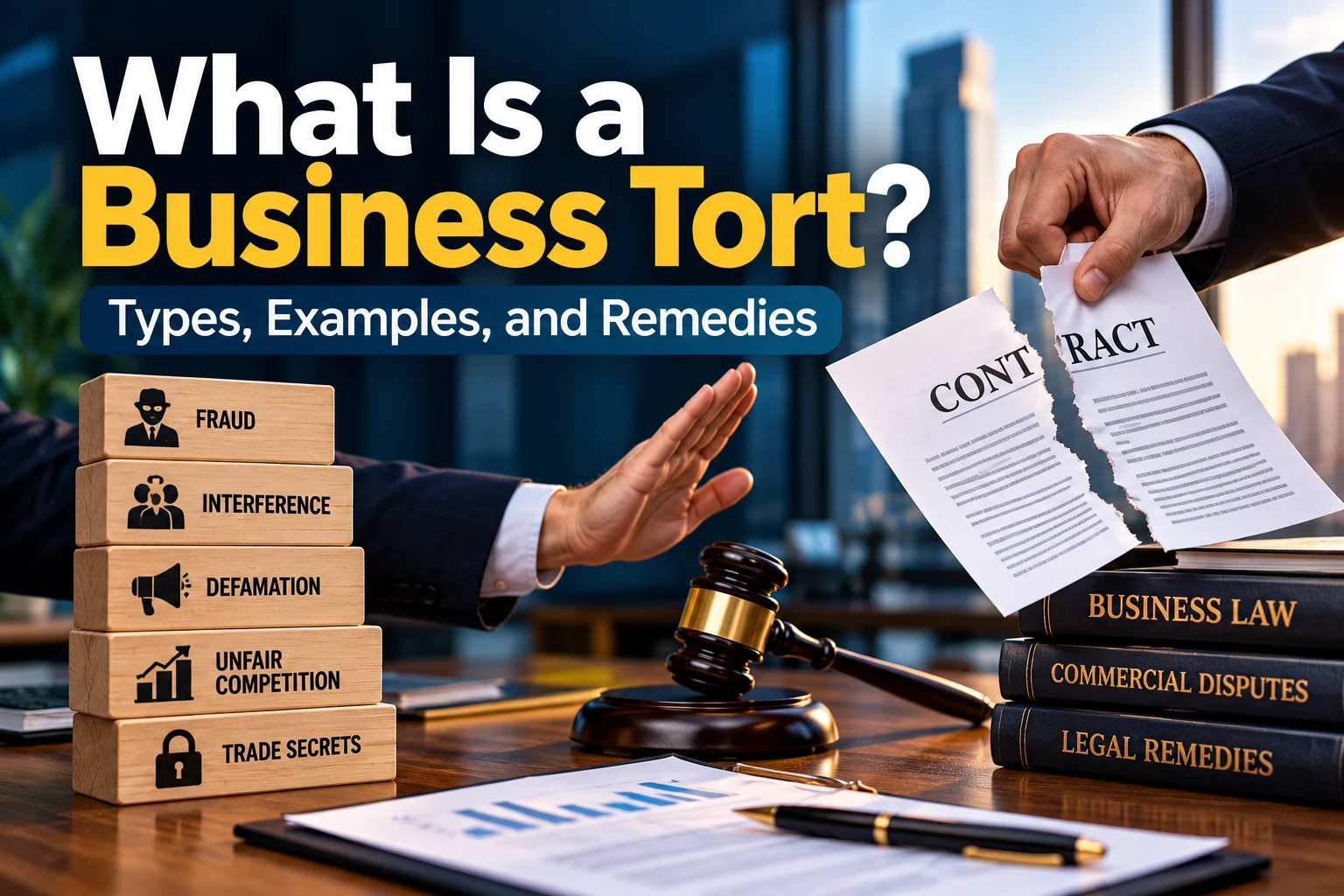





A competitor spreads false information about your company, a business partner deliberately misleads you into investing money, or a third party interferes with an important customer contract. These situations can cause serious financial damage. But are they simply part of doing business, or could they be grounds for legal action?
A business tort is a civil wrong that unlawfully harms a company’s financial interests, commercial relationships, or business reputation. Business torts are also called economic torts because they primarily involve financial losses rather than physical injuries.
Understanding what is a business tort helps entrepreneurs recognize potentially unlawful conduct, protect their businesses, and determine when professional legal assistance may be necessary.
Not every unfair business practice is legally actionable. The law distinguishes between legitimate competition, ordinary contractual disputes, and conduct that violates an independent legal duty.
This guide explains the meaning of business torts, common types, practical examples, how claims are proven, and the legal remedies that may be available under United States law.
What Is a Business Tort in Simple Terms?
A business tort occurs when someone’s legally wrongful actions cause financial harm to another business or its protected commercial interests.
The responsible party might be a competitor, supplier, customer, business partner, former employee, or another organization.
For example, suppose a competing company knowingly tells customers that your products contain dangerous ingredients, even though the accusation is false. Several customers cancel their orders because of that statement.
Depending on the circumstances and applicable law, your company may have a claim involving business disparagement, defamation, or another recognized cause of action.
According to Cornell Law School’s Legal Information Institute, economic torts protect commercial and financial interests, including business opportunities, profits, and market advantages.
These claims generally fall within civil law. Their primary purpose is to compensate injured parties, although courts may sometimes order additional remedies.
Business tort law is primarily influenced by state law, meaning the requirements for establishing a claim can vary significantly across the United States.
What Are the Main Types of Business Torts?
Several kinds of wrongful commercial conduct may qualify as business torts. Each type protects different interests and requires particular legal elements.
1. Tortious Interference With a Contract
Tortious interference with contractual relations occurs when an outside party intentionally and improperly disrupts an existing contractual relationship.
Imagine a manufacturing company has a valid supply agreement with a distributor. A competitor knows about that agreement and deliberately uses wrongful means to persuade the distributor to violate its contractual obligations.
If this conduct causes the manufacturer financial harm, it may support a tortious interference claim.
Courts typically examine whether a valid contract existed, whether the defendant knew about it, whether the interference was intentional and improper, and whether it caused legally recognized damages.
Merely offering better prices or competing for customers does not automatically constitute tortious interference.
2. Interference With Prospective Business Relationships
Businesses can sometimes pursue claims involving future commercial opportunities, even when no final contract has been signed.
This type of claim is commonly called tortious interference with prospective economic advantage or business expectancy.
Consider a construction company negotiating a substantial project. A competitor intentionally makes fraudulent statements to the potential customer, causing the negotiations to collapse.
A legal claim might exist if the company can establish a sufficiently concrete business opportunity, wrongful interference, causation, and damages.
However, an expected opportunity is not the same as a guaranteed contract. Courts often require more than speculation about possible future earnings, and the degree of independent wrongdoing required varies by jurisdiction.
3. Fraudulent Misrepresentation
Fraudulent misrepresentation occurs when someone knowingly or recklessly makes a material false statement to induce another party to rely on it, causing harm through that reliance.
For example, a business owner might provide fabricated revenue statements to persuade an investor to purchase part of a company.
If the investor reasonably relies on those statements and suffers a financial loss, a fraud claim may be available.
The important distinction is between deliberately misleading someone about material facts and making an ordinary prediction that later proves incorrect.
The precise legal requirements differ by state. For more information, see Cornell Law School’s explanation of civil fraud and misrepresentation.
4. Negligent Misrepresentation
Negligent misrepresentation differs from intentional fraud because the person providing incorrect information may genuinely believe it is accurate.
The problem arises when someone supplies false information without the legally required level of care in circumstances where another party is entitled to rely on it.
For instance, a professional adviser might provide materially inaccurate financial information during a business transaction without conducting necessary verification.
If another party reasonably relies on that information and suffers a loss, negligent misrepresentation may become relevant.
Not every careless statement creates liability. Courts examine the relationship between the parties, applicable duties, reasonable reliance, and whether the resulting financial harm is legally recoverable.
5. Business Defamation and Commercial Disparagement
A company’s reputation can influence customer confidence, financing opportunities, and long-term revenue.
Business defamation may involve false factual statements that harm a company’s reputation. Commercial disparagement, sometimes called trade libel or injurious falsehood, generally concerns damaging false statements about a business’s products, services, or property.
Suppose a competitor knowingly publishes false claims that another company’s equipment regularly fails safety inspections. If those claims cause identifiable financial losses, a commercial disparagement claim may be possible.
However, honest opinions, truthful statements, and certain legally protected communications may not support liability.
Defamation and commercial disparagement are related but distinct claims. Their requirements, including proof of fault and financial harm, vary by jurisdiction.
6. Unfair Competition and Trade Secret Misappropriation
Unfair competition encompasses several kinds of deceptive or wrongful commercial conduct. It is not a single uniform tort recognized identically everywhere.
Examples may include misleading consumers about product origins, falsely suggesting affiliation with another brand, or engaging in certain forms of deceptive commercial advertising.
Some practices are governed by state tort law, while others fall under federal legislation, including the Lanham Act.
Misappropriation of trade secrets is another important business concern. It may arise when protected confidential information is acquired, disclosed, or used through legally improper means.
For example, an employee who unlawfully takes confidential manufacturing formulas and provides them to a competitor may expose themselves or others to trade secret claims.
Trade secrets receive protection under both state laws and the federal Defend Trade Secrets Act when applicable. Cornell’s trade secret law guide explains these protections.
Real-World Business Tort Examples
Understanding business torts becomes easier when considering practical business situations.
Imagine an accounting firm has a longstanding client contract. A competing firm knowingly uses fraudulent information to pressure the client into terminating that contract. The original firm loses a substantial source of revenue. Depending on the facts, this could involve intentional interference with contractual relations.
In another situation, an entrepreneur invests $100,000 in a company after receiving deliberately falsified statements about its earnings. The actual financial position is substantially worse than represented. This may support a fraudulent misrepresentation claim.
A third example involves a former employee improperly sharing protected customer pricing information with a competitor. If the information qualifies as a trade secret and statutory requirements are met, the company may have legal remedies.
These examples are hypothetical. In actual disputes, liability depends on the evidence, specific legal elements, available defenses, and applicable law.
Business partners may also become involved in disputes involving fraud, diverted opportunities, or misuse of business property. Our article about grounds for suing a business partner discusses these situations in greater detail.
How Do You Prove a Business Tort?
Successfully proving a business tort requires more than showing that someone acted unfairly or that a company lost money.
The injured party, usually called the plaintiff, must establish the elements of the particular legal claim.
Those requirements differ among fraud, tortious interference, disparagement, and other causes of action. Nevertheless, several important questions commonly arise.
Was There Legally Wrongful Conduct?
The plaintiff must identify conduct that violates a recognized legal duty or meets the elements of an established tort.
Unwelcome competition is not sufficient by itself. A business might lose customers because a competitor offers better service, lower prices, or more convenient products without anyone committing a legal wrong.
Did the Conduct Cause Financial Harm?
The plaintiff must establish a legally sufficient connection between the defendant’s actions and the losses claimed.
Suppose a retailer loses $50,000 in sales after a competitor publishes false information. That decline alone does not prove the competitor caused the entire loss.
The retailer might need to distinguish the effects of the false statements from seasonal demand, changing market conditions, or other business problems.
Can the Loss Be Supported by Evidence?
Depending on the claim, useful evidence may include contracts, accounting statements, customer communications, sales records, and expert financial analysis.
For example, comparing historical profits with documented lost orders may help demonstrate the financial consequences of the alleged wrongdoing.
Accurate accounting is particularly important. Business owners can strengthen their financial recordkeeping by following the principles in our small business finance guide.
Business Tort vs. Breach of Contract: What’s the Difference?
Business torts and contract breaches can both create financial losses, but they arise from different legal obligations.
A breach of contract generally occurs when a party fails to perform a duty established by an enforceable agreement.
A business tort involves conduct that violates a legal duty recognized independently of, or otherwise actionable beyond, the contractual promise.
For example, a supplier failing to deliver equipment by an agreed deadline may create a breach-of-contract claim.
If an unrelated competitor intentionally uses improper methods to cause that supplier to violate the agreement, a separate tortious interference claim may arise against the competitor.
Some commercial disputes involve both contract and tort allegations. However, courts may limit tort claims based entirely on contractual obligations through rules commonly associated with the economic loss doctrine or independent-duty principles.
This distinction is important because simply labeling a broken agreement as fraud or negligence does not automatically create a valid tort claim.
An unpaid commercial invoice is also generally a contract or debt-collection issue unless additional conduct supports another claim. Our guide to business-to-business debt collection explains that separate problem.
What Damages Can You Recover in a Business Tort Case?
The remedies available depend on the specific tort, applicable law, evidence, and circumstances.
Compensatory Damages
Compensatory damages seek to address proven losses caused by legally wrongful conduct.
These may include lost profits, diminished business value, or other measurable financial injuries.
Suppose a wrongful interference claim involves a canceled contract expected to generate $80,000 in revenue. That does not automatically mean the business suffered $80,000 in recoverable damages.
The expected costs of completing the contract, profitability, uncertainty, and other relevant factors may affect the calculation.
Punitive Damages
Some jurisdictions permit punitive damages in particular tort cases involving sufficiently serious misconduct.
These awards are intended to punish and deter wrongful behavior rather than compensate for ordinary financial loss.
They are not available automatically, and legal thresholds and limitations vary.
Injunctions and Other Relief
Courts may sometimes issue injunctions requiring a party to stop certain conduct, particularly where ongoing misconduct threatens harm that cannot be adequately addressed through money alone.
Trade secret disputes may also involve statutory remedies such as compensation for unjust enrichment or reasonable royalties.
The Legal Information Institute’s overview of tort remedies explains the distinction between compensatory relief, punitive damages, and injunctions.
What Defenses Are Available in Business Tort Cases?
A defendant may challenge whether the alleged conduct was wrongful, whether the plaintiff suffered legally recognized harm, or whether the defendant caused that harm.
For an interference claim, the defendant might argue that its actions constituted legitimate business competition rather than improper interference.
In a misrepresentation case, the defense might challenge whether the statement was false, whether reliance was reasonable, or whether the alleged loss resulted from that reliance.
Truth and applicable speech protections can be important in business defamation disputes.
Another major issue is the statute of limitations. The deadline for filing a claim depends on the state and cause of action, and missing it may prevent recovery.
Because defenses are highly fact-specific, business owners should avoid assuming that an aggressive business practice is automatically illegal.
What Should You Do If Your Business Has Been Harmed?
If you suspect that another party has committed a business tort, begin by identifying what happened and preserving relevant evidence.
Save communications, contracts, financial statements, invoices, advertisements, and customer complaints that may establish the alleged misconduct.
Avoid deleting potentially relevant records or accessing another party’s private accounts without authorization.
Next, assess the financial impact using reliable accounting information. Determine whether lost sales, additional costs, or other damages can be reasonably linked to the conduct.
Consult a commercial litigation attorney before making formal accusations, threatening litigation, or contacting the opposing party about a substantial dispute.
A lawyer can evaluate whether the circumstances support a recognized claim, whether immediate legal protection is appropriate, and which filing deadlines apply.
Not every disagreement requires a lawsuit. Negotiation, mediation, or settlement may provide a practical solution when the facts and relationships permit.
How Can Small Businesses Reduce Business Tort Risks?
Preventing avoidable disputes is generally less disruptive than resolving litigation after it begins.
Start by establishing clear contracts, honest advertising practices, appropriate employee responsibilities, and reliable financial controls.
Businesses should also protect commercially sensitive information through confidentiality agreements, restricted access, and documented information-security procedures.
Managers and employees need to understand that customer acquisition should involve legitimate competition rather than deceptive statements, unauthorized information use, or improper interference with existing contracts.
Regularly reviewing commercial agreements and potential conflicts of interest can help reveal problems before they become costly.
Strong recordkeeping, consistent policies, and clearly defined responsibilities support the broader management practices discussed in Businesslineer’s small business management guide.
These precautions cannot eliminate litigation risk, but they can help businesses operate responsibly and respond more effectively when disputes arise.
Frequently Asked Questions About Business Torts
A business tort is primarily a civil wrong. An injured business typically seeks compensation or another civil remedy. However, some underlying conduct, such as certain forms of fraud or theft, may also violate criminal laws. Civil and criminal proceedings have different purposes and legal standards.
There is no universally established most common business tort across all U.S. jurisdictions. Frequently discussed claims include fraudulent misrepresentation, tortious interference, negligent misrepresentation, and commercial disparagement. The types of disputes encountered depend on the industry and business relationships involved.
Potentially, yes. False factual statements that cause legally recognized reputational or economic harm may support claims such as business defamation or commercial disparagement. The requirements depend on the jurisdiction, the nature of the statement, available legal protections, and evidence of the resulting harm.
No. Unfair competition is a broad legal category that can involve common-law torts, state statutes, and federal laws. Ordinary competitive conduct, including offering lower prices or attracting customers through better service, is generally lawful. Whether a particular practice is actionable depends on the legal rules involved.
Yes. Depending on the circumstances, conduct involving fraud, improper use of confidential information, or intentional interference may create tort liability. Business partners may also face claims for breach of fiduciary duty or contractual obligations, although those claims are not always classified or treated as business torts.
Filing deadlines vary by jurisdiction and the type of claim. Certain circumstances may also affect when the limitations period begins. There is no single nationwide deadline for all business tort lawsuits. Seeking legal advice promptly is important because waiting too long can eliminate an otherwise valid claim.
Legal representation is not universally mandatory for every individual plaintiff, but commercial tort litigation can involve complicated legal requirements and financial evidence. Corporations and other business entities may also face rules requiring representation by an attorney. A qualified business litigation lawyer can help evaluate the claim, available remedies, costs, and procedural requirements.
Protecting Your Business Starts With Understanding Your Rights
Business tort law helps distinguish ordinary commercial competition from conduct that unlawfully damages another company’s financial interests.
Fraudulent representations, improper interference with contracts, false commercial statements, and misuse of protected information can create serious consequences when the requirements of a recognized legal claim are satisfied.
For business owners, the most useful approach is to understand the risks before a dispute occurs, maintain accurate records, protect confidential information, and seek qualified advice when potentially wrongful conduct threatens the company.
Knowing what a business tort is does not mean every business setback becomes a legal claim. It means recognizing when a financial problem may involve a violation of legal rights rather than an ordinary cost of doing business.
Legal notice: This article provides general educational information about U.S. business law and does not constitute legal advice. Business tort rules, available remedies, and filing deadlines vary by jurisdiction. Consult a licensed attorney for advice about a specific dispute.